

Conference Recap: Post-Liberalism, An Exploration

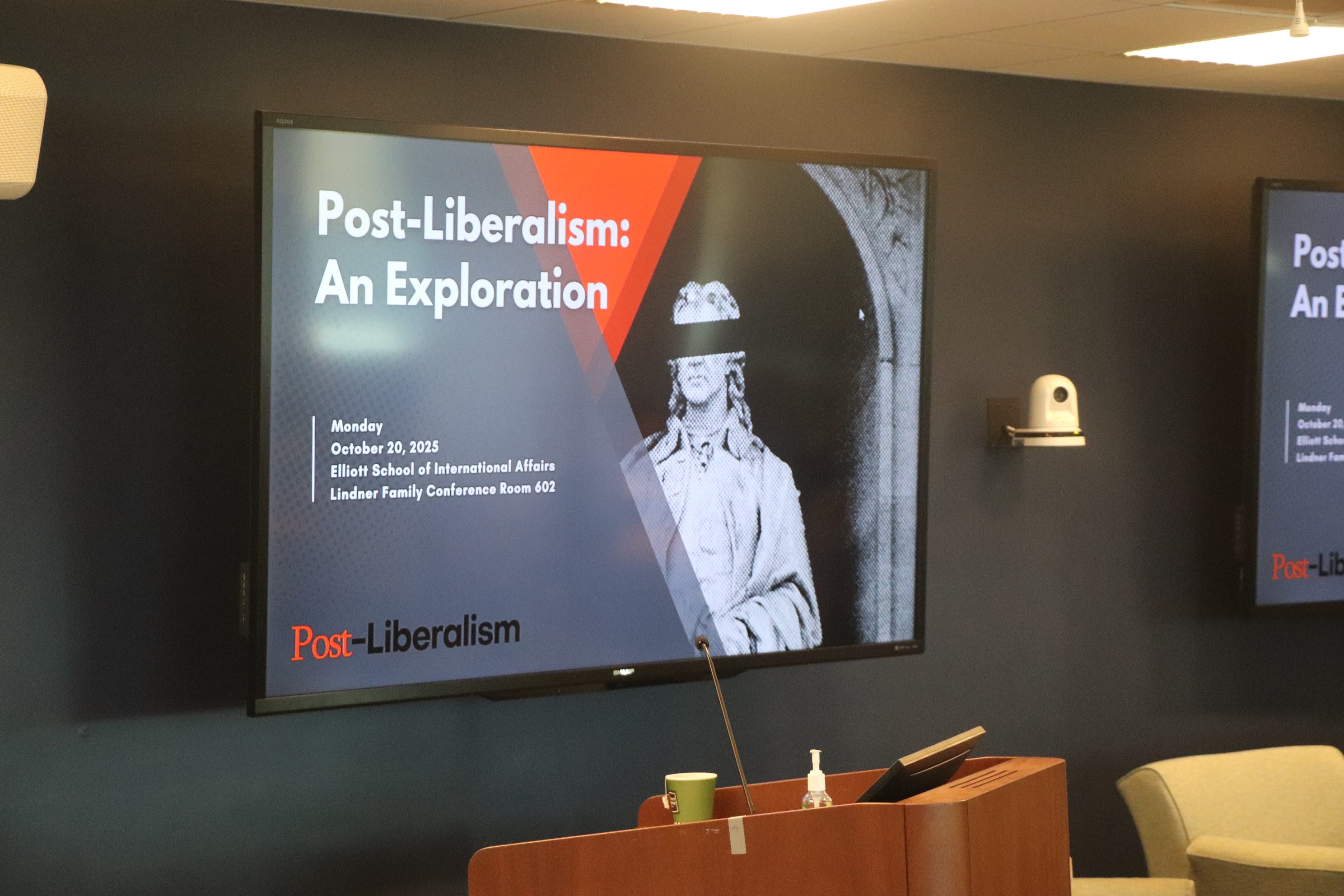
Dear readers, presented below is the agenda that accompanied the Institute for European, Russian, and Eurasian Studies’ conference Post-Liberalism: An Exploration, held on October 20, 2025, at The George Washington University. We have recreated it here for two reasons. First, it is a testament to the exciting and novel work we are undertaking here on our Postliberalism platform. Second, the themes, speakers, and their biographies may be useful resources for those interested in our changing societies and their futures.
In a time marked by deepening disillusionment with liberal orthodoxies, this conference gathers scholars and thinkers to explore the contours of an emerging postliberal imagination. We use post-liberalism as a placeholder for a multifaceted exploration into the crisis of liberal thought and practice and the new political imaginaries that have opened to replace liberalism or compete with its cultural hegemony. While the prefix “post-” presupposes a chronological positioning of what might come after liberalism, we include in our definition a plurality of right-wing and left-wing proposals to reframe our political and social order, as well as possible reimaginings of liberalism itself.
9:00 am | Welcoming remarks from Marlene Laruelle
9:15 - 10:30 am | Panel 1: Is Postliberalism Already Here?
This first panel explores the evolving political landscapes of the United States and Europe through the lens of postliberalism. It examines how liberalism is transforming under the pressures of populism, cultural fragmentation, and economic discontent, and how various forms of illiberalism have emerged in response, offering alternative visions of political and moral order. Panelists will consider whether these developments signal the decline of the liberal consensus or its adaptation to new conditions, and to what extent postliberal ideas are already shaping policy, institutional life, and cultural narratives on both sides of the Atlantic. What is lost when we move beyond liberalism? What, if anything, must be retained from the liberal order?
Chair: Joshua Tait, Ronald Reagan Institute
Adrian Pabst, University of Kent
Helena Rosenblatt, City University of New York
Matthew Schmitz, Compact Magazine
11:00 am - 12:30 pm | Panel 2: Twenty-first Century Christianity versus Technofuturism
To what extent can transhumanism be understood as the next stage in human evolution, potentially enabling the transcendence of our biological limitations? This vision of humanity’s future raises profound ethical questions concerning the desirability and implications of post-humanist trajectories. Should such aspirations be regarded as an opportunity for radical enhancement, or rather as a perilous attempt that risks undermining the very essence of what it means to be human? Furthermore, it is worth considering whether religious traditions, such as 21st century Christianity and others, offer ontological frameworks capable of informing and shaping ethical approaches to emerging technologies, including artificial intelligence. Could these traditions provide sufficiently robust conceptions of human dignity and purpose to ground new forms of technological regulation?
Chair: Jerome Copulsky, Berkley Center
Kevin Vallier, University of Toledo
Leah Libresco Sargeant, Author
Will Wilson, CEO, Antithesis
1:15 - 2:30 pm | Panel 3: Postliberalism, Capitalism, and Class Structures
How can postliberalism fulfill its commitment to the revitalization of local communities and social bonds? What stance should postliberal thought adopt toward capitalism and neoliberalism, given their emphasis on market individualism and global economic integration? Furthermore, is the pursuit of the common good feasible in the absence of a strong state capable of promoting and safeguarding shared moral and social ends? Finally, should postliberals seek strategic alliances with libertarian actors, despite their differing conceptions of freedom and authority, or would collaboration with segments of the political left offer a more promising basis for advancing communal and solidaristic goals?
Chair: Angus Burgin, Johns Hopkins University
Sohrab Ahmari, UnHerd
Elizabeth Anderson, University of Michigan
Stan Veuger, American Enterprise Institute
2:45 – 4:00 pm | Panel 4: Civilization, Nation, Empire, Network Cities?
How might we reconceptualize our collective experience in a world that is increasingly moving beyond liberal paradigms? One possible approach is a renewed emphasis on nation-state sovereignty against supranational institutions, while another considers the potential revival of imperial structures as frameworks for political order. Alternatively, emerging models such as network cities may offer new forms of citizenship and belonging that transcend traditional territorial boundaries. This raises further questions about the existence and coherence of civilizations: can such civilizational identities be meaningfully delineated and preserved in contemporary contexts?
Chair: Peter Slezkine, Stimson Center
Emma Ashford, Stimson Center
Christopher Caldwell, Claremont Institute
Sumantra Maitra, Center for Renewing America
4:15 – 5:45 pm | Panel 5: Humans in their Environment
This panel explores how postliberal thought confronts rival visions of progress. Critics of growth emphasize ecological limits, warning against extractivism and urging restrained, sustainable pathways. By contrast, advocates of abundance argue that radical increases in supply—housing, energy, infrastructure, public services— combined with regulatory reform and stronger state capacity can expand prosperity and reduce scarcity without resigning to permanent limits. Rather than isolating the environment as a technical issue, the discussion situates it within the larger struggle over the meaning of progress: is nature a boundary to respect or a challenge for human ingenuity?
Chair: Gerard Toal, Virginia Tech
Alec Stapp, Institute for Progress
Simon Nicholson, American University
Dirk Philipsen, Duke University
Anatol Lieven, Quincy Institute for Responsible Statecraft
Speaker Bios
Sohrab Ahmari is the U.S. editor of UnHerd. Before that, he co-founded Compact, and served for nearly a decade at News Corp., as the op-ed editor of the New York Post and a columnist and editor with the Wall Street Journal opinion pages in New York and London. In addition to those publications, his writing has appeared in The New York Times, The Washington Post, The Atlantic, The New Republic, The New Statesman, and Dissent, among many others. His books include Tyranny, Inc (2023) and The Unbroken Thread (2021), both published by Penguin Random House. His next book, The Triumph of Normal, is forthcoming from HarperCollins.
Elizabeth Anderson is Arthur F. Thurnau Professor and John Dewey Distinguished University Professor of Philosophy and Women’s Studies at the University of Michigan and specializes in political philosophy, ethics, and philosophy of economics.
Emma Ashford is a Senior Fellow with the Reimagining US Grand Strategy program at the Stimson Center. She works on a variety of issues related to the future of U.S foreign policy, international security, and the politics of global energy markets. She has expertise in the politics of Russia, Europe, and the Middle East. Ashford is also a nonresident fellow at the Modern War Institute at West Point, and an adjunct assistant professor in the Security Studies Program at Georgetown University.
Angus Burgin is Associate Professor at John Hopkins University. He is currently finishing a book on the intellectual history of the internet. Other recent writings on the political economy of technology are available in The Presidency of Donald Trump: A First Historical Assessment (Princeton, 2022), Beyond the New Deal Order (Penn, 2019), and American Labyrinth: Intellectual History for Complicated Times (Cornell, 2018). He is an executive editor of the series Intellectual History of the Modern Age with the University of Pennsylvania Press, and is on the editorial board at Modern Intellectual History, where he served as co-editor through 2022.
Christopher Caldwell is a contributing editor at the Claremont Review of Books and a contributing opinion writer for the New York Times. He was previously a senior editor at the Weekly Standard and a columnist for the Financial Times. He is the author of Reflections on the Revolution in Europe: Immigration, Islam and the West and the New York Times bestseller The Age of Entitlement: America Since the Sixties.
Jerome E. Copulsky is a research fellow at the Berkley Center for Religion, Peace, and World Affairs at Georgetown University. Previously, he served as a Senior Advisor in the Office of Religion and Global Affairs at the U.S. Department of State and was a Jefferson Fellow at the Smithsonian Institution’s National Museum of American History. He is the author of American Heretics: Religious Adversaries of Liberal Order (Yale University Press, 2024).
Helena Rosenblatt Dhar is Distinguished Professor of History and Political Science at The Graduate Center, CUNY and recent recipient of a Guggenheim Foundation Fellowship. She teaches in the PhD Programs in History, French, and Political Science, and the MA Program in Liberal Studies at the Graduate Center. She is also a faculty member of the M.A. Program in Biography and Memoir. Her third and most recent book, The Lost History of Liberalism from Ancient Rome to the Twenty-First Century, Princeton University Press, 2018, recovers the moral core of liberalism by tracing the history of the words “liberal” and “liberalism” across the centuries.
Marlene Laruelle is Research Professor of International Affairs and Political Science at the George Washington University. She is the Director of the Illiberalism Studies Program and the editor of postliberalism.org, and the former Director of the Institute for European, Russian and Eurasian Studies (IERES) at GW. Trained as a political philosopher, she studies the shifting ideological landscapes of Russia, Europe and the United States, with a focus on the rise of illiberal movements and the emergence of postliberal imaginaries.
Anatol Lieven is the director of the Eurasia Program at the Quincy Institute for Responsible Statecraft. He was formerly a professor at Georgetown University in Qatar and in the War Studies Department of King’s College London. He also served as a member of the advisory committee of the South Asia Department of the British Foreign and Commonwealth Office and of the academic board of the Valdai discussion club in Russia. He holds a B.A. and Ph.D. in history and political science from Cambridge University in England.
Sumantra Maitra is the Director of Research and Outreach at The American Ideas Institute, a Senior Fellow at Center for Renewing America, and an Elected Fellow at the Royal Historical Society, London. He is also an advisor to the Congressional Greenland caucus. He coined the Dormant NATO doctrine, and his latest book is titled The Sources of Russian Aggression, published in 2024 by Rowman & Littlefield.
Simon Nicholson is Associate Professor and Associate Dean for Research in the School of International Service at American University. He also co-directs American University’s Institute for Responsible Carbon Removal. He writes and teaches on global environmental governance, the politics of climate change response technologies, and global food politics.
Adrian Pabst is Professor of Politics at the University of Kent and the Deputy Director of the National Institute of Economic Studies. He is a contributing writer to New Statesman and the author of Postliberal Politics (2021).
Dirk Philipsen teaches economic history at Duke University and plays a leading role in Duke’s climate commitment initiative. He is also Senior Fellow at the Kenan Institute for Ethics, director of the Duke University Focus cluster on “Building a Better World,” Fellow at the Royal Society of Arts, and founding associate of the Wellbeing Economy Alliance. His latest book is The Little Big Number: How GDP Came to Rule the World, and What to Do About It (Princeton University Press). He is the co-author, alongside Lewis Akenji, of a forthcoming book on Dignity for All as a foundation for transformative futures.
Leah Libresco Sargeant is the author of three books: The Dignity of Dependence: A Feminist Manifesto (University of Notre Dame Press, 2025), Arriving at Amen: Seven Catholic Prayers that Even I Can Offer (Ave Maria Press, 2015), and Building the Benedict Option (Ignatius Press, 2018). Her freelance writing has appeared in The New York Times, First Things, The Dispatch, The New Atlantis, and others. She runs the substack community Other Feminisms (otherfeminisms.com) and works on family policy in D.C.
Matthew Schmitz is the editor of Compact and co-host of Against the Grain. Previously he was a senior editor of First Things. His essays on politics and culture have appeared in publications including The New York Times, The Wall Street Journal, The Washington Post, The Atlantic, and Politico. A native of O’Neill, Neb., he holds a bachelor’s in English from Princeton University and lives in New York City with his wife and four sons.
Peter Slezkine is Senior Fellow and Director of the Russia Program at the Stimson Center and host of The Trialogue Podcast. He has expertise on US foreign policy, the former Soviet Union, and Sino-Russian relations. He received his Ph.D. in history from Columbia University and has held fellowships at East China Normal University, the Wilson Center, the Clements Center at the University of Texas, Austin, the Belfer Center at the Harvard Kennedy School, and International Security Studies at Yale University.
Alec Stapp is the co-founder and co-CEO of IFP. Previously, Alec was the director of technology policy at the Progressive Policy Institute, a research fellow at the International Center for Law and Economics, a technology policy fellow at the Niskanen Center, and a graduate research fellow at the Mercatus Center. Alec’s work has been published in the Washington Post, The Atlantic, MIT Technology Review, and Politico. He has also been cited in numerous publications including the Wall Street Journal, the Financial Times, and the New York Times. He received his master’s degree in economics from George Mason University and a bachelor’s degree from the University of Arizona.
Joshua Tait is a historian of American conservatism. He holds a Ph.D. from the University of North Carolina and is a visiting scholar at the Ronald Reagan Institute. Between 2021 and 2024, he worked for the New Zealand government. Tait is the author of the “To Live is To Maneuver” Substack and a forthcoming history of the conservative intellectual movement.
Kevin Vallier is a Professor of Philosophy at the Institute of American Constitutional Thought and Leadership at the University of Toledo. He is the author of four monographs, five edited volumes, and over fifty peer-reviewed book chapters and journal articles. His published works include Liberal Politics and Public Faith: Beyond Separation (Routledge, 2014), Must Politics Be War? Restoring Our Trust in the Open Society (Oxford University Press, 2019), Trust in a Polarized Age (Oxford University Press, 2020), All the Kingdoms of the World: On Radical Religious Alternatives to Liberalism (Oxford University Press, 2023).
Stan Veuger is a senior fellow in economic policy studies at the American Enterprise Institute (AEI), the editor of AEI Economic Perspectives, and an affiliate of AEI’s Center on Opportunity and Social Mobility. He is also a visiting lecturer of economics at Harvard University, an affiliate of Harvard’s Center for American Political Studies, and a fellow at the IE School of Politics, Economics, and Global Affairs. He was a Campbell Visiting Fellow at the Hoover Institution in May 2022.
Will Wilson is the co-founder and CEO of Antithesis. Prior to becoming an entrepreneur, he was a mathematician and AI researcher, and worked in software engineering roles at Apple and Google.