

Dirk Philipsen on Post-Growth, Progress and Democracy, and Building a “Wellbeing Economy”
An interview with Dirk Philipsen

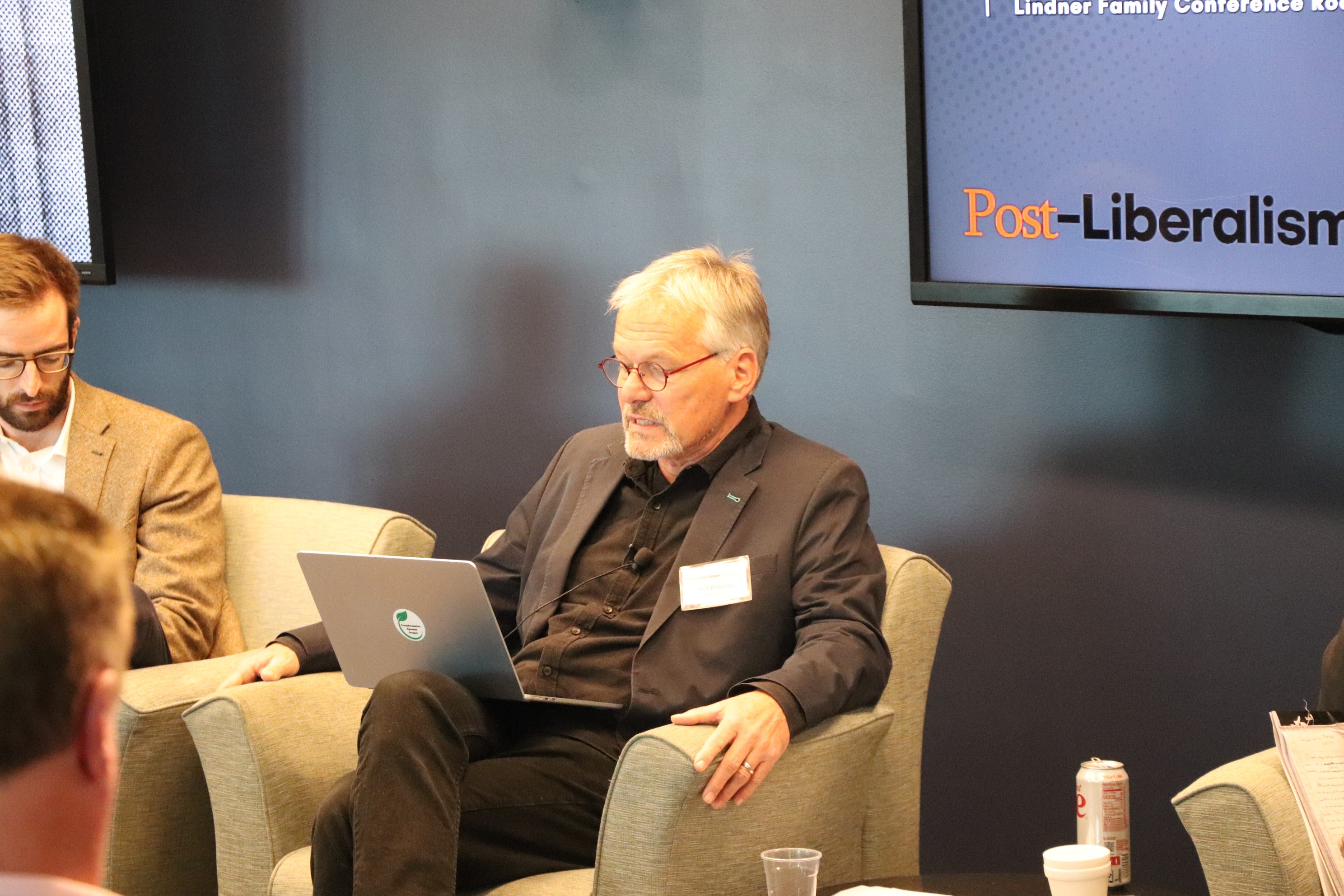
Dirk Philipsen delivers remarks at the Institute for European, Russian, and Eurasian Studies’ conference Post-Liberalism: An Exploration, held on October 20, 2025, at The George Washington University.
Dirk, you have argued in many articles and in your latest book, The Little Big Number: How GDP Came to Rule the World, and What to Do About It, that GDP and the discussions and rankings based on it is a broken compass for analyzing economies. Could you summarize for our readers what is fundamentally wrong with the growth-centric ways of understanding our economy today, and specifically the metric of GDP?
What is wrong with GDP and what is wrong with a growth-centered economy are two slightly different questions. I started analyzing GDP as more than just a metric, for it is also a goalpost of today’s economies. It is about as singular and as basic, i.e., rudimentary, of a metric as you can possibly imagine because it counts nothing other than market transactions: what goods and services are bought and sold in the marketplace. It makes no differentiation as to whether these goods and services are good or bad. It has no insight on what impact they have on society, whether they create inequality or enormous amounts of environmental damage. None of those things are part of the metric. If you want a “wellbeing economy”—or strive for any other kind of valuable purpose, like sustainability of fairness or equity or opportunity—GDP as a metric is a complete failure.
Having said that, it is also important to note that just changing the metric would not change the system, because GDP is actually a pretty well-suited metric for the nature and logic of capitalism. Here I would say the same thing about capitalism that I said about GDP, which is that capitalism is effectively a system defined by its systemic imperative to grow forever. That imperative comes from its singular goal of growth and profit. In that sense, both capitalism and GDP are profoundly and simply, using the words of systems thinker Donella Meadows, and not putting too fine of a point on it, “stupid.” Why? Because their exceedingly narrow lens does not take into account anything that real people care about, whether that is freedom, justice, sustainability, or any other value that sustains or improves lives.
Economists like to claim that economic growth drives human wellbeing—that there is a close correlation between growth and wellbeing. But the evidence is actually remarkably thin. Many of the gains we celebrate—like rising life expectancy—stemmed not from growth at all, but from basic public health measures such as sanitation. And some of the most profound advances in human dignity—the abolition of slavery, the end of child labor—emerged not because of capitalism’s logic, but in direct resistance to it.
There are two key aspects of capitalism that one should note. One is that it is a system that always takes more than it gives back. Two is that it is a system that by definition has to grow forever and exponentially. This requires a little bit of clarification, because in my experience as a scholar and teacher, I have found that even smart academics can’t really wrap their head around the exponential function. Exponential means that, if you followed what economists would generally consider to be a healthy growth rate of about 3%, the economy would have to double in output roughly every 24 years. You would very quickly get to the point where every five-year-old would tell you that this is complete and absolute insanity. It’s absurd to think that we could do that, and it’s absurd to think that we would find it desirable. I want to say that very clearly: what every smart five-year-old would understand to be insane is what drives economic policymaking in every advanced modern economy in the world today.
From socialists all the way to right-wing autocrats, all have one thing in common: they support this idea of exponential economic growth. They differ with each other really only in terms of how to most effectively bring growth about and then distribute its rewards. But if you try to find an economic system or an economic school of thought or a political party anywhere in the Western world that recognizes that exponential growth is impossible, literally making us passengers on a train hurtling towards the cliff, you will find none. I don’t know a single one, including green parties and left parties, which effectively leaves people who do my line of work without a political home altogether.
You say that everybody, from socialists to radical neoliberals, believes in the exponentiality of growth. That means that, to move toward a post-growth strategy, we need to recuse not only the neoliberalism that has been predominant since the 1980s but the last 200 years tout court, given the fact that these years have been characterized by the liberalism-capitalism dyad. A lot of the left’s criticisms of today’s status quo centers neoliberalism, but to what extent do we need to go further back in time and rethink the notion of progress itself, in both its economic and technological forms, as we’ve known it since at least the early 19th century?
The way you frame the question, of course, makes it sound daunting—and it is in some ways. To clarify what I’m saying, it is indeed true that I think that every major political ideology—nationalism, capitalism, socialism, communism, fascism, liberalism—has that fundamental defect: none of them are useful for charting a path towards a future of wellbeing for people and planet.
All of them are actually tied up with the larger architecture and project of capitalism. They are, in some form or fashion, a way to promote, respond to, or ameliorate some of the effects of capitalism. In that sense, of course, what I am saying is profoundly and historically anti-capitalist. By that I don’t mean necessarily to give up on markets and I certainly don’t mean to give up on choice and freedom or development and innovation. I very much mean to give up on a system that reduces, in Karl Polanyi’s words, nature and people to commodities, and a system that functions for one purpose and one purpose only: growth and profit.
There’s no question in my mind that we will soon see this system as a very strange and dangerous detour that we took in history. So, yes, I am questioning all of those projects, every single one of them. And I question them in large part because they all happen within the larger architecture of a system called capitalism that is fundamentally moving us in the wrong direction.
How much do you think that capitalism is also deteriorating democracy and democratic resilience? In many ways, the incredible visibility and power of Big Tech help us see that technological progress is no longer a progressive force, as it has been framed for so long. Rather, it may be a threat to, or at least weakening, democracy. But can that also offer us an opportunity to say that a resilient democracy is based on a vision of progress that is post-growth?
There are two questions that you’re raising, one about progress and one about democracy. Starting with progress, most “modern people” would also define progress almost exclusively as a function of economic growth, by which they effectively mean GDP growth: we see progress when economies grow, when output grows, and when demand grows. Progress, thus, is not necessarily a function of happiness, wellbeing, sustainability, social justice, safety, or any of those more human-centered metrics, which confines us to a very narrow spectrum of things to talk about. So, I would question the way we define progress in the first place.
Next, this notion that capitalism and democracy go hand in hand is bizarre to me. There are historical examples galore showing not only that they do not support each other, but that they are, in reality, in direct conflict with each other—and always have been. The point of a good capitalist is to undermine democracy (and the market, by the way) and monopolize his position, because that is how you most easily make a lot of profit. We have in history dozens and dozens of autocratic, fascist, nationalistic, non-democratic societies that have been capitalist.
I also think this is a good moment to raise this question of what we mean by democracy. I have been arguing this forever with many other people, that what America calls a democracy was always a very truncated form. But it is now becoming obvious that we are moving in a direction where, what I may have previously considered an oversimplification by Karl Marx, namely that the state is the executive committee of property-owning capitalists, is in fact increasingly true. So, I don’t know what people mean by democracy. If 340 million people in America have the choice between two parties, both of whom are completely capitalist parties, both of whom effectively buy into the same economic logic, it’s a bit like going into a bar and being told that the choices of drinks are Diet Coke and Diet Pepsi. Since I don’t like either, I probably will turn around and leave, which is basically what half of Americans regularly do—they no longer vote because they feel like it’s useless. This is also why we have these very strange political phenomena of people voting in the same election for Alexandria Ocasio-Cortez and Donald Trump. Again, Karl Polanyi knew this: people will revolt and push back when they no longer have options. That’s where we are.
It is not surprising to me that there is an increasing conflict between what we call democracy and capitalism. When you talk about Big Tech, that’s just a more serious and modern iteration of the very same dynamic: a concentration, to put it bluntly, of naked power, immense amounts of money, and increasingly weaponized access to information in the hands of ever fewer people. We are having this conversation at a moment in history that likely stands out as featuring the highest level of inequality we have ever seen: we now have a world in which 1% of people own more wealth than the rest of the 99%. That means, for all intents and purposes, that any and all conversations about freedom, justice, and democracy are over before we even start them. Unless and until we begin to address this level of concentrated power and wealth, and begin to take steps toward equalizing it more, I think all these other conversations are just simply doomed, which is why I’m writing a book on private poverty.
If you just visualize the planet for a second, this amazing and hospitable body we call the blue marble, this little ball that is hurtling through space, not only does it become pretty obvious that drawing artificial borders—calling one place Canada, and the other one the United States, and the next one Mexico—and envisioning this as something that can be owned by people and used according to whatever whims the owners have, is a slightly bizarre idea. What it means in terms of politics and economics is that we cannot avoid addressing and rethinking this question of who owns what and why.
In a post-growth world, what would the role be of the state and of the private sector? Moreover, what role would technology play, how could it be understood in a post-growth world? In other words, how might we rethink many of dynamics that we have, for so long, taken for granted?
I’ve begun to worry about terminology like “post-growth” or “de-growth.” I still think it’s important to use these terms because the singular fixation on growth is the elephant in the room. However, in no shape or form do they allow people to imagine a future. So, to be clear: what scholars in the post-growth arena are really arguing is that, rather than organizing our economy—and with it our politics—around the goal of growth, we should organize it around achieving the greatest wellbeing for the greatest number of people within the biophysical boundaries of the planet, so that we can survive and live well.
This could mean a lot of different things and probably should mean a lot of different things in different places, contexts, and countries. It certainly will continue to involve technology, efficiency, and development because we want people to live well and to not do jobs that nobody wants to do. But we also want to do this in a way that does not burn up the planet and destroy the very foundation on which we stand. I can go into far more specifics on what this might look like in each and every case, but the key is really that once you begin to change the goalpost and begin to develop metrics, criteria, and regulations around the question of what impact they will have on the wellbeing of people and planet, how you act, build, and develop will change radically.
I just had a graduate student in my office who was talking about the fast fashion industry, for instance. What’s the problem with fast fashion? Everything is wrong with fast fashion, but where would you stop it? On the one hand, we have a lot of stressed and lonely people who often don’t have enough money and so are going out to buy clothes all the time in order to feel good about themselves. On the other hand, you have an industry that really couldn’t care less about fashion, people, or the planet; it cares about its bottom line, its return on investment. So, they come up with every conceivable way to sell more clothes. The cheapest, most toxic, most terrible clothes that you could possibly imagine, but the more, the better. As long as you have a system that functions on those principles, there’s no hope. We can engage in all kinds of campaigns around the world trying to tell people they shouldn’t do this and go to Patagonia instead, but none of that is going to change much. What will change things is to change the architecture and operating logic of the system itself. No longer reward this ravenous, predatory, destructive, and extractive operating system. Instead, reward and incentivize things that actually contribute to the wellbeing of people and planet.
How do we move toward that? How do we help citizens construct their own transformative visions? Citizens have themselves been socially shaped to be consumers and see their status in terms of income and consumption, and so that subjectivity would need to change. Likewise, without grassroots pressure, the corporate world will not change. So the question is where to begin and what kind of cultural work can be done to help citizens consider that what matters is well-being, care, and sustainability?
That’s, of course, the $6 million question. If I had an easy answer for that, I would probably not be sitting here. However, I don’t want to dodge the question either. I think where we begin is on all fronts. We need all hands on deck and we need everybody who is willing to contribute to that project. The reality is that we will not always succeed in building what we envision. But it is definitely also true that we cannot build anything without envisioning it first. I think we find ourselves in a world with essentially two political narratives. One is a sort of authoritarian or fascist version (Putin, Bolsonaro, Trump etc.) and the other one is neoliberalism (Macron, Harris, Merz). As I just pointed out, both have in common some fundamental flaws that are disqualifying when trying to build a stable and functioning democracy, much less a sustainable economy. Where’s the third alternative, the third political narrative? It’s just not there.
If I don’t understand what the root of the problem is, I will have a really hard time coming up with answers and solutions. Once there is a conversation that points out very clearly that the root of the problem is capitalism—specifically, the element of capitalism that always takes more than it gives back and always must grow—then we can begin to have a democratic dialogue about how to address that problem and build a new vision around it. This is what tens of thousands of people are beginning to do around the world. I am merely a small part of a much larger collective effort to create a political narrative and vision that can guide us towards a post-growth, wellbeing society. To be sure, we haven’t worked out all the details, nor should we, because this needs to be a project that everybody who is interested can participate in.
It also needs to be a project that looks different in France than it does in Zimbabwe or Russia. But its principles are clear; we have made enormous progress in laying them out and the book I’m writing on property will contribute to this as well. That’s the work that needs to continue, so that when you ask the question “where and how can I contribute,” we have a long list of things you can do within your community, region, state, and nation, whether you are an economist, an artist, a teacher, a nurse, or a programmer. We can at least have a north star to work towards. We need to build alternative places where people can become actively involved. In my workplace, for instance, we need to have economics departments that actually teach this. Right now, I cannot send my students to the economics department and say, “take this course on wellbeing economics,” because it doesn’t exist. That’s a tragedy.
This also very much includes having parties that actually represent us, so that I have somebody to vote for. Personally, I have voted in every election over the last 40 years in this country, and yet I have only really voted for someone once; all the other times, I was essentially forced to vote against someone else even worse. That’s not democracy. That’s corporate capture. So, on all of those levels we can immediately start working—right here, today.
Do you think people are ready to hear and embrace that?
Oh, do I think? I think it’s safe to say, “I know!” We had a post-growth conference in Oslo where we thought we could maybe get 150 people. 1,500 people signed up! See the latest election in New York City with Zohran Mamdani. These people are more than ready. The young people that I work with at the university every day are so ready for a different narrative that can give them some hope and prospects, not just a little less crap. If ever there was a moment ready for a third political alternative, this is it.
What about the usual criticism that we often hear? For instance, that post-growth is only a prospect in the Global North whereas, in the Global South, people still need growth and consumerism to develop first? To what extent does the North have to, in a sense, pay the price before the Global South can be asked to also move towards post-growth? This view has good points related to fairness and redistribution. How do we address the legitimate concern coming from the Global South about the cost of development?
I’m very glad that you bring up this really important question. Again, a little bit of historical context is important here: the question makes sense only if you assume that growth actually translates into benefits for people. It just simply doesn’t. The reason the Global South is impoverished—and is actually continuously developing the Global North, as evidenced by the fact that there’s far more money and resources going from the Global South to the Global North than the other way around—is precisely because of this growth regime. If you are engaging in an activity that harms people and planet, arguing that the people who have been harmed should continue this regime in order to get out of it just makes no sense.
Now, does that mean that we therefore don’t have a responsibility towards the Global South? Not at all, quite the opposite. But it does mean that I think it’s probably safe to say that the Global South would’ve fared better if the Global North left it completely alone—not extracted, not enslaved, and not made it dependent. It is also true, now that it has stolen and extracted so much, that the Global North has a responsibility to give back. In large part because of exploitation and colonization, the Global South now indeed has a lot of need for development. And, in some cases, also growth.
But in reality, development is not at all the same as growth; after a basic level of wellbeing, you can actually develop much better without overall growth. It’s obvious, for instance, that you would like your two year old to grow—she has to if she wants to be healthy. But when she’s twenty, you would be insane if you forced her to continue to grow in size—eventually you would end up killing her. Instead, you now want her to grow in experience and learning and such, not size.
That’s the thing: capitalist growth economies can’t make this distinction. So, they force us to grow until we die. It’s the logic of the cancer. Unless, that is, we finally decide that there are much better ways to organize an economy. Cut out the cancer, and instead focus on wellbeing of people and planet.
Dirk Philipsen teaches economic history at Duke University and plays a leading role in Duke’s climate commitment initiative. He is also Senior Fellow at the Kenan Institute for Ethics, director of the Duke University Focus cluster on “Building a Better World,” Fellow at the Royal Society of Arts, and founding associate of the Wellbeing Economy Alliance. His latest book is The Little Big Number: How GDP Came to Rule the World, and What to Do About It (Princeton University Press). He is the coauthor, alongside Lewis Akenji, of a forthcoming book on Dignity for All as a foundation for transformative futures.