

Is Post-liberalism Already Here? A Dialogue

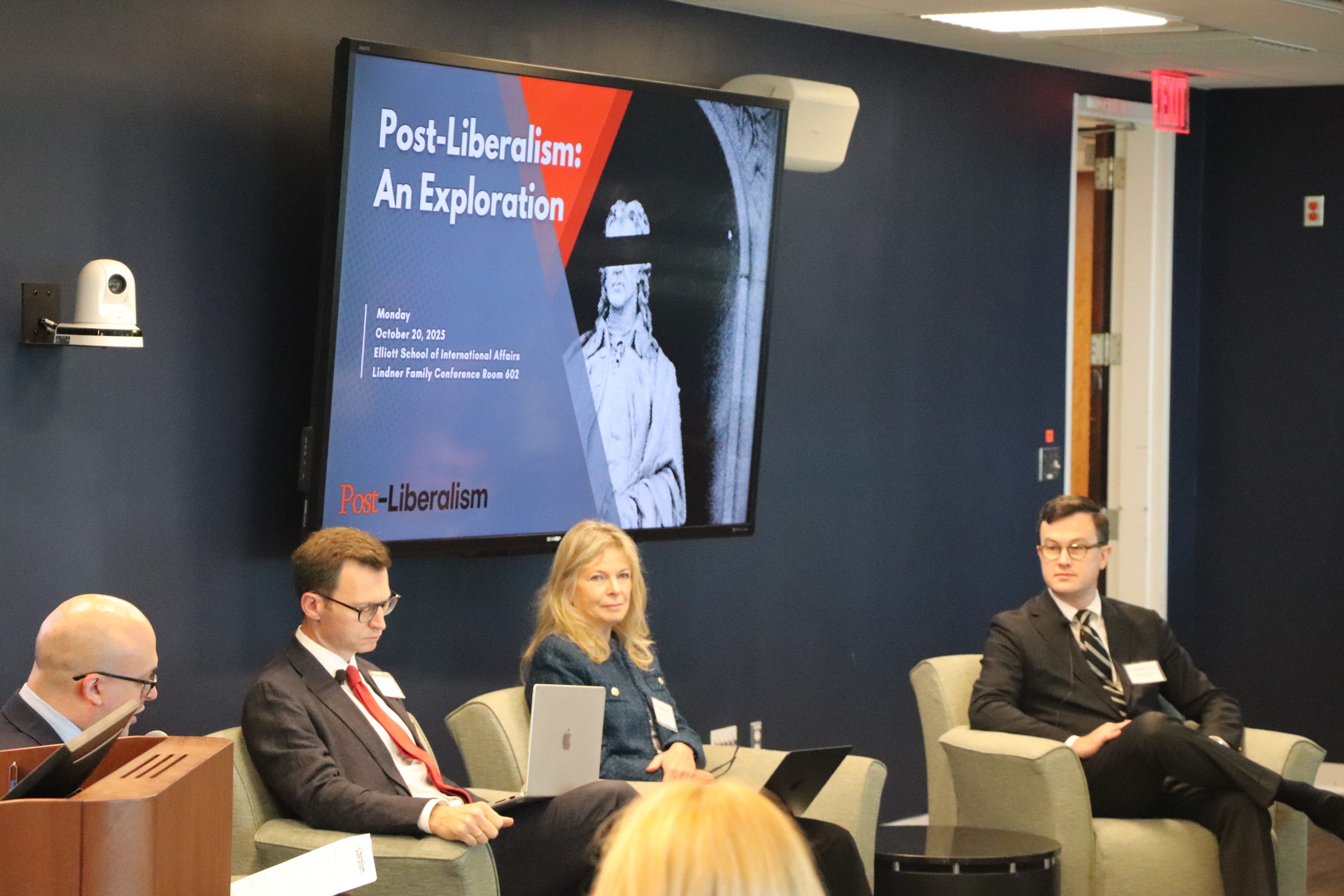
This article is based on comments delivered at the Institute for European, Russian, and Eurasian Studies conference “Post-Liberalism: An Exploration,” held on October 20, 2025, at The George Washington University.
Joshua Tait: Good morning, everyone. First of all, I would like to thank Marlene, John, Laura, and anyone else working behind the scenes for organizing this conference. I think it will be an extremely interesting, generative, and thoughtful discussion, and I am very grateful it is being put on.
Our panel this morning is on a question I think that many of us—perhaps all of us—are wondering, which is: Is post-liberalism already here?
Speaking first, we will have Professor Helena Rosenblatt, Distinguished Professor of History and Political Science at The Graduate Center, CUNY. She is the author, most recently, of The Lost History of Liberalism: From Ancient Rome to the Twenty-First Century published by Princeton University Press. It is, I think, one of the most important and useful intellectual histories of liberalism to have come out in recent years, but also more generally.
Speaking second, we will have Professor Adrian Pabst, who is a Professor of Politics at the University of Kent and the Deputy Director of the National Institute of Economic Studies. Adrian will discuss a particular form of post-liberalism, speaking to the wide variety of post-liberalisms that we will have on discussion today.
Finally, we will have Matthew Schmitz. Matthew is the former editor of First Things magazine and the co-founder and current editor of Compact. In a different context, the historian John Patrick Diggins once described a journal as “noted for the perversity of its brilliance,” and I think Compact has some of that. He is also the co-host of the “Against the Grain” podcast.
Without any further ado, I will pass to Helena.
Helena Rosenblatt: Yes, liberalism is in crisis. I worry about consumerism, narcissism, technocracy, environmental degradation, and so much more, but I do not think “liberalism” is the problem or cause of our problems. It would be more correct to say that we are not living up to our liberal principles. Our problems are the result of our inability or unwillingness to fully realize liberal principles. Speaking as a liberal, I would say that we are not delivering. We may have recently lost our way, but we have the resources within our tradition to make a course correction. Liberalism is resilient and self-correcting. Liberalism’s institutions allow for critique, reform, and renewal.
We live in dangerous times; let us work together to save liberal democracy. Now is not the time to knock it. Post-liberals are, of course, not all the same. Some are openly anti-liberal. Others say that they are not anti-liberal, they just want to move beyond liberalism, and they advocate some very reasonable things that I think liberals can easily agree with, like rebuilding civic institutions and voluntary associations. They want to restore trust, dignity, and human relationships. Sure, let us do that. I do not know a liberal who does not want to do that, but what all post-liberals share is the goal to replace liberalism or move beyond it.
I think that is wrong-headed and not helpful at the critical historical moment we find ourselves in. And what, anyway, do post-liberals mean by liberalism? It is a moving target, it seems to me. Sometimes it is a form of government. Sometimes it is the ideas of a political party. Sometimes it is capitalism or libertarianism, but then sometimes it is big government, sometimes it is the right, and sometimes it is the left, and then often it just means moral laxity, corruption, and everything that is wrong in society. Who is not against everything that is wrong?
Well, what post-liberals also share, I regret to say, is a tendency to describe liberalism in a self-serving way that is historically inaccurate and sometimes frankly absurd. A sure way to know that someone is a critic is when they begin talking about Hobbes as if he were a liberal or a proto-liberal. False. Another is when they start saying that liberals believe in the disembedded individual. Also, false and disproven many times. Liberals, I read yesterday on the train, are apparently cynics with a pessimistic view of human nature. False! I do not know which liberals they are reading.
When the dust settles, post-liberal criticism often boils down to cultural matters. Liberalism, they say, is a selfish ideology responsible for moral decline. It obsesses about individual rights and freedoms at the expense of duties to one’s family, one’s community, and religious values. Liberal individualism, they say, erodes social bonds.
Let us get a few things out of the way. Founding liberals gave us hard-won and cherished principles such as constitutional government, equality before the law, the separation of powers, jury trials, and a number of individual rights and protections, including freedom of religion, freedom of the press and speech, and the right to private property. Are we ready to jettison any of these? Some post-liberals apparently are. Later liberals fought for improved working conditions, the regulation of child labor, antitrust laws, the right to unionize, food and drug safety standards, social security, and unemployment insurance. Which of these do we want to abandon or leave behind? And which of these is morally degrading? Which of these is responsible for moral decline? I am just asking. Individual rights are not selfish. To advocate for individual rights is to be generous. Liberal individualism bids us to regard one another as primarily individuals and not as trapped members of a group.
Liberal individualism instructs us to see others as equals in merit and dignity—as persons worthy of our respect and consideration, as worthy of the same opportunities regardless of their class, race, religion, gender, or any group identity, even family. Early liberals advocated individual rights precisely so that people could better perform their duties. They believed that, for a human being to be truly moral, he or she must be able to make moral decisions freely and voluntarily. Authoritarianism, whether political or religious, imposes decisions on people. But true morality cannot be coerced, and liberals recognize that families, communities, tribes, nations, and religions can be oppressive and coercive. Poverty is, of course, coercive as well. Liberalism does not erode bonds: it encourages voluntary, authentic ones. Groups, as we all know, religions, communities, tribes, nations, even marriages and families, can be oppressive. Thank goodness for the right to divorce.
I will conclude with one last liberal accomplishment: throughout most of their history, liberals have advocated for both negative and positive freedom because freedom from coercive authority and dependence gives you the freedom to do what is morally right. That is not the same thing as being morally lax or even neutral. Individual freedom gives you the possibility of becoming—or the space to become—a better, more generous person, a better, more generous spouse, parent and citizen. Thank you.
Adrian Pabst: Thank you, Marlène, for bringing us together. Let me begin with this quote by a French philosopher talking to an English empiricist: “It may well work in practice, but does it work in theory?” My argument is that political liberalism rests on a flawed philosophy, while “really existing” post-liberalism is a poor reflection of post-liberal ideas. Another way of saying this is to suggest that post-liberalism is already here in theory, but it is certainly not here in practice. So, if anyone tells you the Trump Administration is post-liberal, I would very much caution against drawing such a conclusion.
I think there is a growing body of work developing post-liberal ideas. It is based on excavating history, as Alasdair MacIntyre and many others have done, and renewing radical traditions that are absent from contemporary conversations because these contemporary conversations are very much stuck in this binary opposition between progressivism and populism, which just descends into mutual demonization. Post-liberalism, at least the kind that I and others defend, seeks to transcend this by proposing a paradoxical politics that is radical on the economy and moderate on culture, transforming the capitalism of big finance and big tech in the direction of an ethical market economy, and rebuilding social ties after the ravages of liberal individualism. That is not the same project as populist, anti-liberal responses to our current crisis. It is actually examples like the Danish Social Democrats and Blue Labour in Britain that come closest to a “really existing” post-liberalism, but they are by no means a perfect exemplification of post-liberal ideas.
Now, I am very skeptical about liberalism for several reasons. First of all, contemporary liberalism is all about liberal progressive globalization; the consensus in the West after 1989 was really a fusion of left-wing social-cultural liberalism and right-wing economic liberalism. As Alan Wolfe remarked already in 1998, “the right won the economic war, the left won the cultural war, and the center won the political war.” This sums up essentially where we were for 30 years after 1989. It is not to say there are not any policy differences between Clinton and Bush, or Obama and Trump, or Biden and Trump, but there was a deeper consensus, certainly until the second Trump election.
Second, the reason why this consensus has really fallen apart is that that form of progressive liberalism has become intolerant, ungenerous, and uncivil. The more diverse its messengers are, the more homogenous it has become in thought and social class. The more liberal it has made the market, the more authoritarian its surveillance capitalism has become, as Shoshana Zuboff has shown. Liberalism actually undermines the very fundamental freedoms it purports to uphold, such as freedoms of conscience, speech, association, and religion.
Third, and this is true for “really existing” liberalism, if not perhaps for all liberal theory, but many contemporary liberals end up endorsing a progressive politics that engages in lawfare and cancel culture. It celebrates Hamas and defends China, while siding with oligarchs and despising workers. Many contemporary liberals in politics have been on the wrong side of history. I am not saying it is the Soviet Union by other means, but “really existing” liberalism has created the conditions of alienating millions of voters and workers. If we are getting populism, that is, in large part, a backlash against the progressive policies of contemporary liberalism.
Fourth, liberalism has absolutely no monopoly on these fundamental freedoms. It did not invent them; it inherited them from Greco-Roman philosophy, Christianity, and the Middle Ages. That is a matter of historical record. No doubt the liberal traditions added institutions to this legacy, such as the free press and more independent courts, but no political philosophy or ideology has a monopoly on these ancient freedoms, liberalism no more than conservatism or socialism.
Fifth, it is not just that contemporary liberalism is in crisis. Liberalism as a whole is in question. Now liberalism does not have a single essence, but I think it is characterized by what Wittgenstein called “family resemblances.” I’ll just mention a few of them. The primacy of the individual, not in sociological or cultural terms, but in ontological terms. This is part of the philosophical tradition of nominalism rather than realism—in intellectual history, John Duns Scotus rather than St. Thomas Aquinas. A nominalist conception rests on the claim that things can be reduced to an individual substance rather than participating in a common source of being.
Linked to this is the primacy of the will over the intellect—in intellectual history, William of Ockham rather than St. Augustine. This ends up replacing notions of substantive goodness or truth with the ultimacy of subjective rights, which are henceforth voluntaristically grounded. Yes, liberalism defends rights and responsibilities, but it does so based on a formal social contract that is artificial and arbitrary. This amounts to the substitution of formal unity for substantive unity, grounded in redefining virtue as “virtù,” as Machiavelli did. In this manner, both the classical virtues, like justice and courage, and the three theological virtues of love, hope, and faith, are replaced by notions of force and military prowess. Machiavelli’s conception of life is more fundamentally agonistic than potentially peaceful. This is why Machiavelli and Hobbes are indeed proto-liberals. Their conception of the sovereignty of the individual and the collective has very much shaped subsequent liberal thinking, namely through the reduction of freedom to the dichotomy between positive and negative liberty, forgetting that freedoms are fundamentally and irreducibly relational. All the freedoms hang together, and each of them depends in the final instance on religious freedom: you cannot just have one type of freedom rather than another. You either are in favor of freedom or you are not.
The privileging of “progress” towards negative liberty and the supposed laws of history entails a kind of necessary rationality that must logically take precedence over tradition and contingency. Liberalism is founded upon a deterministic logic, which is why it is inevitably drawn towards positivism, as Maurice Cowling showed. And in short, liberalism accords primacy to utility and rights rather than virtue. Now to the extent that there are genuinely different strands of liberal thought, they are hybrid—as in the work of Montesquieu, Burke, and Tocqueville—and cannot be claimed as pure liberals, especially since these authors reject the nominalist and voluntarist logic of liberalism. So, the new liberalism of T.H. Green, J.A. Hobson, and L.T. Hobhouse clearly rejects the ontological primacy of the individual, but it is less clear whether John Rawls does too. His conception of justice as ground-rules of fairness for isolated individuals behind the veil of ignorance in “A Theory of Justice” foregrounds his entire political philosophy, which is only qualified later in “Political Liberalism.”
Turning to contemporary politics, I reiterate my earlier point that many apparent examples of post-liberalism are anything but. I do not think Viktor Orbán is a post-liberal. I think he is an anti-liberal who also defends state capitalism and things that are oddly closer to economic liberalism, if by that we mean the convergence of state and market to the detriment of society. The Trump administration is similarly anti-liberal on culture and society and ultra-liberal in economic terms, unleashing capitalism within the U.S., secured by a wall of protectionism. “Neo-liberalism in one country.”
Therefore, I think we need to ask which version of post-liberal politics comes closer to a true post-liberal theory. I have my reservations about National Conservatism and some versions of Catholic integralism. I find them too focused on the sovereign state, which is really just the sovereign individual on a larger scale. I find them too focused on identity politics and combining that with market nationalism.
I will finish with this: there are different forms of pluralist post-liberalism in the work of Michael Lind, Sohrab Ahmari, my comrade Matthew Schmitz, but also the work of Frances Foley, Claire Ainsley, and many others. The version of post-liberalism we defend emphasizes resisting capitalism, because capitalism commodifies both humans and nature, and also resisting the authoritarian central state. What we need is more subsidiarity, which is best suited to temper the pharaonic tendency of centralized state power. Sovereignty is necessary to resist the domination of capital, but it is not enough. You don’t want to exchange globalization for market nationalism, so you need subsidiarity to resist the tyranny of the state.
All of this is predicated on democratic solidarity as the most fundamental ethic of society. In short, the post-liberal politics I defend combines the personalist emphasis on the primacy of interpersonal relations based on reciprocity: a democratic, social corporatism built on a new covenant between business, labor unions, brokered by government. Then there is the communitarian value of free, democratically self-governed associations and a much-enhanced role for intermediary institutions in the policy and the economy, requiring the renewal, not just of our universities, but also international solidarity with allies old and new. That includes a democratic Ukraine, which does not necessarily have to endorse any one particular government. Both anarchy and tyranny are real threats in the economy and politics today. I am not sure that the progressive liberalism we see at the moment, in reality—or indeed some of the liberal theories—represent the best way to overcome this. The alternative is a democracy founded upon solidarity. The sharing of burdens as part of a hard and merciless life can generate a more virtuous politics to domesticate the demonic energy of the free market and the central state. In short, solidarity, status, and subsidiarity are the three pillars of a post-liberal politics that I would defend. Thank you.
Matthew Schmitz: Speaking at the Catholic University of America in 2023, then-Senator J.D. Vance said, “There is no meaningful distinction between the public and the private sector in the United States.” His remark was met with outrage. “This is how the right lays the predicate for even more comprehensive state control of the private sector, including plowing through constitutional limitations on state authority,” wrote David French, the New York Times columnist. The outcry showed how reluctant many remain to acknowledge the reality of our politics. Ideological combatants on both sides speak as if we face a great choice between liberalism and post-liberalism or illiberalism. The truth is less dramatic.
Long before Donald Trump entered office, Americans were ruled by a system that melds public and private power while enlisting non-state groups in the task of governance. Such an order is neither liberal nor socialist, but corporatist: as a matter of economic and social organization, if not in ideology, America is resolutely post-liberal. Corporatism, an economic and social theory that arose to address the perceived limits of liberalism and socialism by offering a “third way” beyond them, is often associated with the discredited regimes that arose in Europe in the middle of the 20th century. But, as the political scientist Howard Wiarda has shown, the term has broader applications. It exists wherever, one, politics is organized, not in terms of individuals but in terms of corporate units such as family, race, sexual identity, business lobby, or interest group; two, the state seeks to organize, coordinate, or control these groups; three, the groups seek benefits from the state while the state seeks to incorporate them into its governing structures. All three of these conditions are satisfied in the United States.
Anti-discrimination law accords special consideration to certain racial groups. Administrative rulemaking procedures operate, not on the democratic basis of one man, one vote, but instead by seeking input from recognized actors such as business lobbies, labor unions, and environmental groups. Both the right and the left promote state intervention in the economy to advance a substantive vision of a common good, even if they do not use the term. For the Biden administration, this was an ESG ideal, incorporating environmental considerations, like renewables, a social vision stressing sexual freedom and human rights, and governance factors, including labor rights. For sectors of the Trump coalition, industrial policy is tied to a desire to revive strong families and communities, while bolstering national defense.
Americans tend to deny or downplay the corporatist elements of their regime because they think of themselves as liberal and individualist. Despite the self-image, America has long undergone what we are to describe as a form of creeping corporatism, the unacknowledged growth of a non-liberal mode of governance. One early instance of American corporatism came during World War I, when Woodrow Wilson established the War Industries Board in order to ensure adequate production and guard against strikes. The government board brought together the labor leader Samuel Gompers, with businessmen like Bernard Baruch, and the classically corporatist tripartite model of coordinating business, labor, and state. Yet the real beginnings of American corporatism came with World War II and the New Deal. This was gradual incremental societal corporatism, not abrupt and authoritarian. For this reason, some just prefer to describe it as “pluralism” or even “interest group liberalism.” But under whatever name, corporatism remains a familiar feature of American life.
When Wiarda wrote about corporatism in the 1990s, he argued that it was still limited and partial. Since then, it has become more complete. We have seen not only social media companies coordinating with intelligence agencies, but also the spread of diversity requirements and HR mandates, which have given private corporations an important role in enforcing current understandings of civil rights law. In countless domains, we have undergone what Wiarda describes as “the merging of the public and private sectors.”
None of liberalism’s self-styled defenders are prepared to roll back these developments. Indeed, left-leaning defenders of liberalism are generally eager to preserve our quasi-corporatist regime. They defend green energy subsidies, administrative agencies, and legal recognition of racial groupings, all important elements of our actually existing corporatist settlement. Something similar can be said about the tech right, the other important force in American life that can lay some claim to defending liberalism in economic, more than cultural terms. Elon Musk’s Department of Government Efficiency did seek to roll back certain elements of our corporatist state, particularly those embedded in administrative agencies. The founder of SpaceX and beneficiary of government EV mandates—along with Silicon Valley more generally—is highly dependent on state intervention in the economy. Far more than any beneficiary of affirmative action, he owes his success to our corporatist settlement. He will not unwind the thing on which he depends.
Our political choices, then, are not between liberalism and some alternative to it. They are between two types of corporatist regime: one tilted toward the interests of labor and other democratic constituencies, and the other toward defense contractors and their allies in the GOP. The responsibility of intellectuals is to describe the situation accurately and to clarify the stakes of the choice we face.
Joshua Tait: I think we have three very distinctive positions and analyses staked out here. Helena has suggested to us that liberalism may be in crisis, but it has within it a deep reservoir of self-correcting resources that we ought to draw on. Adrian has suggested that post-liberalism may be here in theory but not necessarily in practice, but certainly the collapse or crisis of the post-1989 consensus suggests something must give. Matthew has suggested that post-liberalism, or something else that is not liberal, has crept up on us and is the reality that we face today.
I want to make a very brief historical digression. First, in 1971, the Philadelphia Society, a conservative academic organization, had a conference on a post-liberal America. They looked at liberalism as exhausted, and they looked forward to a new non-liberal, perhaps conservative future. But, nine years later, we had the Reagan Revolution and, 19 years later, the so-called “end of history.” We can jump back to 1933, and the launch of the traditionalist journal, “The American Review,” where—on the right and on the left—sophisticated intellectuals thought of liberalism, parliamentarianism, and democracy as utterly exhausted. Yet in the 1950s, I think we can reasonably speak about the high point of American liberalism in the United States. So, I want to ask: are reports of liberalism’s death exaggerated? Could we be on the cusp of another liberal renewal? To put it a slightly different way, is post-liberalism an expression of a recurrent traditionalist, perhaps Catholic, criticism of liberalism and modernity that we see time and again?
Helena Rosenblatt: Yes, I think you are on to something: what we are seeing is a kind of repetition of what has happened before.
Adrian summarized his position really well and succinctly, and I agree with a lot of what he says. But you will notice that he mentioned Hobbes, even Machiavelli, and said that liberals admire Hamas and are responsible for cancel culture, when many of us are absolutely appalled by this. There is a small minority of liberals who have kind of hijacked the conversation, and some liberals have been too timid in denouncing this in universities, perhaps myself included. But do we really want to go back to Aristotle and Aquinas?
As you know, liberalism, as a term and as a concept, appeared in the early 19th century. That is when the word was coined, and that’s when the concept—a bundle of ideas—came together. It drew from a long tradition of thinking but had evolved past the main concerns of the Middle Ages, thankfully.
Do we want to give up on pluralism? As to the question of Catholicism, there is a discernible Catholic coloration to post-liberalism; sometimes the references are overt, sometimes not. Catholics, as I also describe in my book, have been adamantly opposed to liberalism from the very beginning, and many of the criticisms we are hearing today from post-liberals are a repetition of what we have heard from the beginning. The word “liberalism” was actually invented as an insult – “isms” frequently were. Liberalism was called a heresy, and it was related to Protestantism. Often it was called a form of Protestantism.
Adrian Pabst: I think one thing we may want to do, even if it is an imperfect distinction, is to say that there are intellectual traditions going back to the 19th century or even earlier on the one hand, and then there are what I called the “really existing” political expressions of those theories. Let me be very clear: I do not think that contemporary progressivism is the only possible expression of the liberal tradition. Of course, there could be many others. Nor do I think that progressivism is somehow totally disconnected from the liberal tradition. Clearly, there are some close links, even if I do not think that progressive and liberal are wholly synonymous. But yes, I think there is an interesting question related to genealogy and whether liberalism, though clearly emerging in the 19th century, as Helena very rightly reminded us, has very deep philosophical and indeed theological roots.
And I do think some of this does go back to the Middle Ages, which I do not think we should just dismiss. Not everything was bad in the Middle Ages, just like not everything is good in modernity: let us have a more sophisticated conversation about certain legacies from the Middle Ages. It was not all absolutism and feudalism, which actually came later than the Middle Ages. The point about liberalism is that its origins do go back to nominalism and voluntarism, as the work of Louis Dupré and Alain de Muralt has shown. And that, to me, has a fundamental philosophical difference with realism. The moment you assume that there is only the individual, in ontological terms, and there is only the will, and that everything else is subordinate to those two things, then we are already in philosophically very problematic territory.
I think the question, then, is what forms of liberalism, philosophically and politically speaking, can guard us against those sorts of positions? I think they are ultimately hard to reconcile with anything like democracy, solidarity, the idea that all freedoms go together, and that freedom also requires some form of purpose. It is not all about the will, and it is not all about negative liberty. And, if we want to have a positive conception of positive freedom, not just a negative conception of positive freedom as I think some civic republicanism has, then we really need to be able to talk about the ends of human life. Too much of liberalism essentially says, no, we can never agree on this. Let us agree to disagree and just settle for some formal procedural arrangements; all goods or forms of flourishing are just matters of individual choice.
I think there is something more covenantal about the world. We are born into forms of intergenerational relations, as Burke and others pointed out, and not all of that is bad. Whilst, of course, we must guard against excesses all the time and, where liberalism has built institutions that help us guard against that, I welcome it. But for every liberal institution that we can mention, we can also point to liberal institutions and practices that go in the other direction and incentivize or reward human vice. Hence, I reject the idea that liberalism has a monopoly on the fundamental freedoms or duties that characterize human beings.
Matthew Schmitz: Helena rightly raised the question of Catholicism, and I want to clarify that there are lots of Catholics—historically and also at the current moment in American life—who are very strongly liberal. There has been a kind of Catholic color in a lot of post-liberal discussions as well. It is very important to realize that, if we live in a democratic country and there are religious people in it, their beliefs are going to be reflected in public discussion, reflected to some degree in public policy. I think we should celebrate the kind of rambunctiousness of our public and intellectual life. Some provocations may not go anywhere or be misguided, but whether it comes from a Catholic place or you have a kind of Protestant Christian nationalists should realize it is part of the mix in America.
But I think it kind of gets at the broader question of pluralism. For a lot of religious believers, something began to really shift in America around 2015. That is the moment when you had the Supreme Court’s decision in Obergefell v. Hodges, recognizing a right to gay marriage, and then the rainbow flag was projected on the White House. This struck a lot of believers, and I can speak from that position, a lot of conservatives, as just a little odd, maybe in the way that a more liberal or non-religious person might feel if suddenly “Christ is king” were just projected on the front of the White House. It is not that everyone was being dragged into court like that one unfortunate baker in Colorado or being endlessly persecuted, but there was something that seemed non-pluralistic in that moment. It seemed to be excluding the views of religious believers.
There is obviously a complicated story about the right and gay rights, and Trump has sort of embraced gay rights more, at least in the abstract. But I think that was an important moment for spurring a lot of these post-liberal discussions; I would rate its significance equally with Trump descending the golden escalator.
Joshua Tait: We have plenty of political theorists here, including myself, but I am enough of a historian to want to know about the material conditions underlying the transition that we are potentially experiencing from liberalism to post-liberalism. When I think about the emergence of liberalism, I think about urbanization, literacy, marketization, the rise of the bourgeoisie, infrastructure, and so on. Matthew got us some of the way to this discussion, and, with the idea of politics as it actually is rather than as it is in theory, what are the material conditions that underlie the crisis of liberalism and the rise of a form or multiple forms of post-liberalisms?
Helena Rosenblatt: I am not an expert on this at all, but I think that it is the vast income inequality. The polarization of wealth is a real problem. I also agree with the problem of Musk and corporate power in America. We have technological developments that nobody seems to even be able to understand or control, the AI revolution, first and foremost. People are not close to understanding what it is going to do to our economy and to our lives. So that is a lot of the problem.
Adrian Pabst: I think it is unhelpful to try to separate economic from cultural drivers because ultimately, we inhabit a single reality rather than all these separate spheres. The problem with a lot of modern philosophy is that it divorces nature from culture and sees them as diametrically opposed, whereas anthropology teaches us that things are more unified.
For example, work gives us not just an income to feed ourselves and our families but also a sense of purpose. A home is not just a physical shelter; it also provides a sense of emotional stability. Culture and the economy, the material and the symbolic, really tend to go together more than we assume. In that sense, I think our situation is one of atomization, insecurity, and a lack of meaning and purpose. While no one political ideology is to blame, the current progressive consensus hasn’t helped because it has done damage to both the material and the symbolic dimensions of our lives.
Nor do I think that populism is the answer. I see a lot of retreat into very nasty forms of ethno-nationalism, even eugenics, which is something that started on the left in the 19th century but has migrated between the right and the left since. In the online sphere, a lot of the critiques of liberalism come with all of that, which I totally oppose. But the question we have to ask is how we can secure the material, as well as the symbolic, dimensions of our everyday lives better than we have done? And that does mean we have to really value the dignity of labor. We must value relationships and reciprocity, which underpin solidarity.
More fundamentally, we need to remember our primary relationality: that we are embodied and embedded in relationships with each other, with past generations and future ones, as well as with nature. The political conversation should be about which institutions, ideas, policies, and practices can help us in that sense. Because, ultimately, humans have a natural desire for knowledge, for self-improvement, for flourishing. The conversations should really be about the conditions for that, rather than progressivism or anti-liberalism. I am not really that interested in that conversation. I am more interested in the fundamental cultural and economic—or the material and symbolic—dimensions of life.
Matthew Schmitz: In terms of the economic causes of our present crisis, my contention is that it lies in our basically corporatist model of government. I think the last real stand against that model occurred under Reagan and Thatcher. It is worth asking why that did not work: why they were not able to move us back to a more liberal form of government, one that was more economically liberal, more politically and socially liberal, with its stress on individual rights rather than entitlements?
I think you saw that, with the attempt to shrink government, there seemed to be an outsourcing of government functions to more private actors. So, we ended up with what was supposed to be a sort of liberal resurgence instead of moving us into the state where we now exist, where maybe the government is smaller, but then there are these less directly accountable actors governing more of our lives. All this has just moved us further down this corporatist line of development.
It is also interesting to ask: what became of democratic socialism? Maybe it is still there: Zohran Mamdani is doing pretty well in New York, and he certainly focuses on economic issues, like affordability and his subsidized grocery stores. But in general, I would say that a lot of the energy that once existed around the Bernie phenomenon has dissipated. I see the left today as less focused on the kind of class issues that it tried to raise during Occupy Wall Street and more focused on questions of identity, belonging, and nationhood. You see that with its very strong commitment to the cause of Palestine. So, there has been a move away from economic questions on the left. I do not really know why that is, but I just find it interesting: I think there was a kind of high-water point of millennial socialism, but we are now past that, at least in class terms, despite Mamdani’s rise.
Joshua Tait: I am intrigued that you mentioned Reagan and Thatcher as a lost, possible turning point or possible turning point, because when I look at contemporary society, I see a very fractured culture. Many people trace that to what is often called “neoliberalism,” which was born at that stage. I wonder, is the post-liberal future just more liquid modernity? With that in mind, I wonder, what are the most plausible political structures for a post-liberal polity? Who has moved beyond critique to theorizing, and perhaps even realizing, a post-liberal political order?
Helena Rosenblatt: I agreed with almost everything that Adrian said, but there was one thing that struck me, when you said that not all forms of flourishing are okay: who is to decide what forms of flourishing are okay? When post-liberals talk about the common good, who decides this? And then how do we get there? Who decides what a family is? You seem not to appreciate pluralism, but I do not think, correct me if I am wrong, that pluralism, or individuals, cause wars. Groups cause wars, religions cause wars, and nations cause wars.
Adrian Pabst: What I am saying is that there is a natural human desire for flourishing, which is much more than just the exercise of rights or the pursuit of utility. Flourishing is substantive, not formal or procedural, grounded in conceptions of the good life, and of course, there will be conceptions that are not only incompatible but even incommensurable with each other. The question of how we debate this and who decides is absolutely a very important one to which I will come back in a moment. But when forms of life go against the dignity of the person and the dignity of work and the intrinsic worth and value of nature, I think we do have to ask questions.
That is not to say that one authority has the power to decide this over all others. I firmly believe in democracy and in a free, robust debate, but it cannot just be that we live by pure procedure. And so, the question is, how do we bring substantive goods and substantive truths back into public debate? I entirely defend and endorse forms of pluralism. It is the monist forms of post-liberalism that I reject, just because they are not pluralist. But, to answer Josh’s question: I think the institutions that are necessary, though perhaps not sufficient, to bring about a good form of post-liberalism in reality are all the intermediary institutions in which state and market are—or should be—embedded. We need to pluralize both state and market organizations and, for that, we do need civic associations.
As Tocqueville showed, America is different from other parts of the world because it used to have, and still does have, very vibrant civic associations, much more so than in parts of Europe where, for instance, the French Revolution destroyed intermediary institutions. Over time, especially in the wake of 1989, the convergence of the free market and an increasingly centralized bureaucracy has hollowed civic society.
Going forward, we need to mutualize the market much more so that not just small and medium-sized businesses, but also large companies work for a social purpose, not just economic profit. We also need a much better balance of organized capital and organized labor. Civil society should not be a third sphere, but actually the primary sphere that embeds the market and the state in social relations. As Karl Polanyi argued, we need to have a social embedding of state and markets so that they can work better than they currently do. But I think these are not sufficient conditions. Sufficient conditions would include political leadership that is virtuous and brave, as with Martin Luther King, Mandela, or Václav Havel, but also the post-war leaders in Europe, such as Schuman, de Gasperi, Spaak, Adenauer, de Gaulle, Attlee, and Churchill.
We also need a cultural transformation that means that we actually live by those virtues, including the dignity of life in all its forms, the dignity of work, and so on. When it comes to the question of who decides, the answer is in some sense nobody, not an individual or a single institution. It should be through democratic debate. But today, democracy too often means certain elites or certain forms of oligarchy or plutocracy that decide. Moreover, we will continue to have a massive democratic deficit until we have democracy at the workplace and in local communities, and so on. I struggle to see how even the legislative route is always wholly legitimate because, to give you one example, we have a Labour government in Britain elected with over 400 seats in the House of Commons out of 650—a two-thirds seat majority—on a vote share of not even 34%. The Labour government has now decided to bring in legislation on assisted dying, which was not in its election manifesto. While this might be in line with the democratic procedure in parliament, I am not convinced that it is legitimate. I am questioning the fundamental democratic nature of our politics, and I think we need to be able to raise those questions, not immediately be attacked as anti-liberal, anti-progressive, or intolerant.
Matthew Schmitz: What is the exemplary post-liberal regime of post-liberal politics that actually exists? In the way that I understand the term, it would actually be the Biden administration that had the most thorough thought out and successful vision of a post-liberal politics through its industrial policy, trying to advance a certain vision of the good of environmental improvement of national defense, and bringing along left behind regions. We have not seen anything similarly comprehensive and thought-out from the right in terms of state intervention in the economy. We have not seen that from Trump, though Trump did begin that shift. Furthermore, some of the intellectuals around the Biden administration were open to talking about, if not the common good exactly, then talking in ways that were not entirely liberal in their accent. I think that is really the most comprehensive experiment we have seen with it so far.
It had a left tendency and obviously there are liberal elements of it, but, to me, the most kind of thorough going experiment we’ve had in something that looks like post-liberalism, that’s trying to address the perceived failures of liberalism by intervening in the market in really aggressive ways and articulating a certain vision of the common or public good that’s able to harmonize diverse and seemingly opposed interests.
In terms of pluralism, I will just say that, for me, marriage is not hard to define: it is the union of a man and a woman. A third of Americans believe that as well; they do not recognize gay marriage, and they are part of our society. It is a democracy, and they have a say. I do not think their opinion is going to come out on top anytime soon; they are very seriously outnumbered, but that is the way things work. People have disagreements and, if things change, maybe one day Obergefell will be effectively reversed. That could happen, and I would see that as totally consonant with our constitutional and democratic traditions.