

On Post-liberalism and the Return of the Common Good
By Stefan Borg

This article is adapted from remarks delivered by Stefan Borg at an event with the Institute for European, Russian, and Eurasian Studies on January 26, 2026.
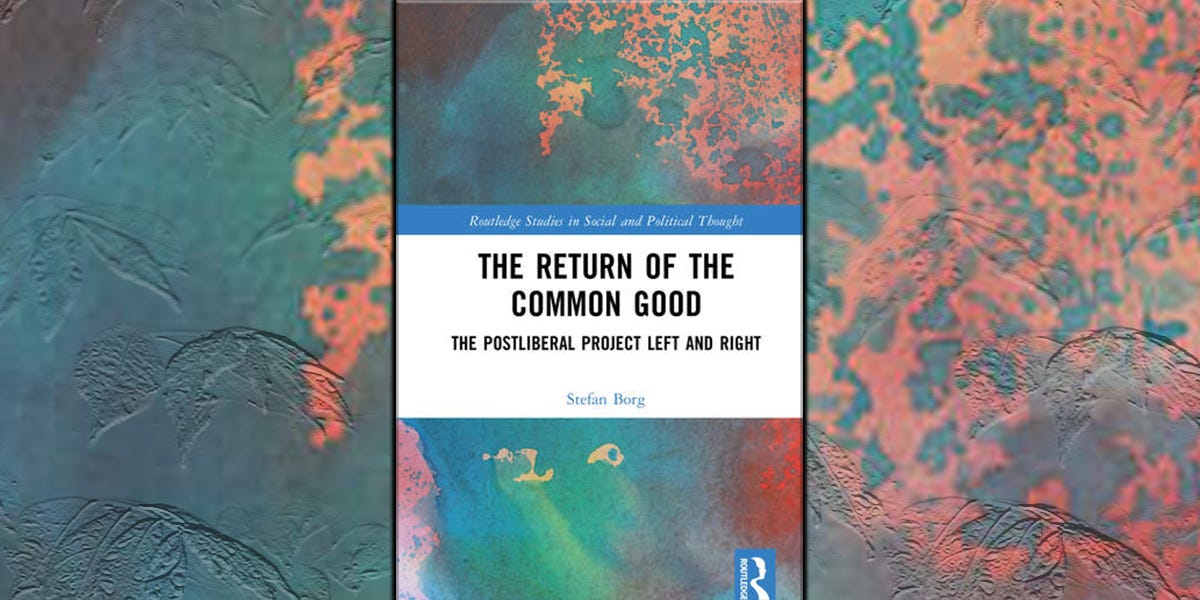
So, the book is called The Return of the Common Good: The Postliberal Project Left and Right. I wanted to write a reconstruction and intellectual history of post-liberalism as rigorously and as fairly as I could, that both post-liberals and liberals would appreciate and find fair. It is not a polemical work and it is ultimately an argument, I think, for taking post-liberal ideas seriously as an intellectual enterprise, and one that resonates with quite a lot of people.
To start off, some three years ago, I wrote an article published in the European Journal of Social Theory where I argued for a specific interpretation of post-liberalism as a strand of thought. And what I found particularly intriguing, and what I wanted to highlight and further explore, was that this critique was politically ambiguous. It came from the right and from the left. So, the book is very much a development of some ideas that I put forward in that article. In this talk, I will start by saying a few words about why I felt it was worthwhile to write a book about post-liberalism. Then I will discuss the origins of post-liberalism, as I understand it in this book. From there, I will present a reasoned definition of post-liberalism according to its main component parts—again, as I understand it in this book. And finally, I will raise some criticisms of post-liberalism.
Why Post-liberalism…and Who Counts?
First things first: why write a book about post-liberalism? Well, it is, of course, a widely used label. The label is also understood by different people in rather different ways. It has been very hard to make sense of what post-liberalism really means. Another reason to write a book about post-liberalism is that quite a few contemporary liberals have, since the early 2020s until now, engaged with post-liberalism or key thinkers in this tradition. However, work on post-liberalism tended to only actually deal with the American branch—America here meaning the United States—and to treat post-liberalism as something wholly on the right of the political spectrum. Finally, the reason to write a book on post-liberalism has much to do with the fact that, in addition to being a set of ideas, post-liberalism is also a political project in an important sense.
Before I offer a definition of post-liberalism, I think it would make sense to say a few words about who I think should be included here, because at the end of the day, the book is deeply inductive in that sense.
So, the post-liberals are essentially a bunch of philosophers, theologians, political and social theorists, as well as public intellectuals. The British branch of post-liberals includes John Milbank, Adrian Pabst, Maurice Glasman, David Goodhart, Philip Blond, Mary Harrington, and Louise Perry. The American branch includes Patrick Deneen, Adrian Vermeule, Gladden Pappin, Chad Pecknold, Michael Lind, Sohrab Ahmari, Christine Emba, Erika Bachiochi, and also, in some important diagnostic dimensions I think, somebody like Catherine Liu, actually.
There is also a set of 20th century thinkers who post-liberals typically draw on, a list that includes Karl Polanyi, James Burnham, Christopher Lasch, and Alasdair MacIntyre. The latter is key, as MacIntyre’s critique of liberal modernity echoes many of the themes taken up both by British and American post-liberals. But there are also, I think, many similarities between the communitarian critics of liberalism from the 1980s and 90s and the post-liberals today. It is my belief that Michael Sandel, for example, can be seen as post-liberal adjacent in important ways.
Of course, for post-liberalism to be a meaningful label, it must denote an understanding of liberalism that has a certain degree of specificity, which is something that I will return to below. Prescriptively, post-liberals disagree quite strongly on alternatives to the liberal order. Some post-liberals are on the left, some on the right, and some say that they embrace a kind of ‘radical center.’ Given all of this diversity, I still argue that there is a certain “core” to the post-liberal project, which I will turn to shortly.
Post-liberalism’s Origins…and What is Liberalism, anyway?
But first, let me just say a few words about the origins of post-liberalism, first in the United Kingdom and then in the United States. The deeper roots of British post-liberalism lie in a particular Christian theological and philosophical school of thought known as radical orthodoxy, which is highly critical of liberal modernity and primarily associated with theologian and philosopher John Milbank. Though figures like Catherine Pickstock, Graham Ward, and certainly Adrian Pabst—one of the most important contemporary British post-liberal thinkers—are also associated with it.
That said, the most immediate origin of British post-liberalism, as a movement, lies in the formation of what became known as Blue Labour in 2011. Blue Labour was founded by the academic, a political theorist actually, Maurice Glasman, who is also a Labour party life peer in the House of Lords. Blue Labour was highly critical of the market-friendly New Labour project championed by Prime Minister Tony Blair and his successor, Gordon Brown. Some of the leading people associated with Blue Labour argued at that point that in the past decades, “corporatist, localist, federal, and institutional politics came to be replaced by a liberal and consumerist kind of politics that ceased generating the leadership necessary to sustain a democratic movement.”
Now, when it comes to the United States, we can say that Trump’s first election opened the door to an extensive debate on the meaning of conservatism. And I think one could say that there are at least three strands of “post-fusionist” conservatism in the United States: the National Conservatives, the West Coast Straussians, and the Post-liberals. Post-liberalism in the United States, then, mostly originated within American academia, though some politicians also voiced support for post-liberal sounding themes (Marco Rubio and J.D. Vance, perhaps most notably). As mentioned above, Patrick Deneen, Michael Lind, Adrian Vermeule, Gladden Pappin, Chad Pecknold, and Sohrab Ahmari, can be understood as the most important post-liberal thinkers in the United States.
As I alluded to above, to understand post-liberalism we first need to understand how they understand liberalism itself. To give a very abbreviated account here, let me first say—and this is key—that post-liberals typically approach liberalism both as a political theory, i.e., a set of propositions and assumptions about the world that you find in a particular canon of texts from Hobbes, Locke, Mills, Rawls, and so on, and also as a sociopolitical project of ordering societies in specific ways, a worldview that is instantiated in social structures, in institutions and human practices. Once again, this is very much in line with how Alasdair MacIntyre understood liberalism.
Liberalism is, of course, about so many different things. But the core of the liberal project, post-liberals believe, lies in a desire to do away with everything that impedes the exercise of human will. In other words, liberalism desires to maximize the sphere of individual autonomy. Post-liberals thus argue that liberalism should first and foremost be understood as a form of philosophical voluntarism, since liberals throughout history, they argue, have prioritized human will over other faculties such as intellect or emotion. So, human will is the crucial faculty for liberals. For liberals, in this telling, life is ultimately about liberating our will. So, the implication of this is that anything that could potentially limit or constrain human autonomy comes to be seen as suspect in some fundamental sense. Community, norms, culture, religion, tradition, family, even modern science—all can be viewed with suspicion if they appear to put constraints on human self-mastery.
Three Components of Post-Liberalism
From here, I think it is safe to begin discussing what I think of as the three core components of the post-liberal worldview. The first component, or dimension, of post-liberalism concerns its account of change. This account of change is macro-historical and is an account of how liberalism undermines itself in various ways. This is, of course, a sweeping argument to make, and there are quite a few ways of characterizing this erosion. But the key here is that the post-liberal story goes something like this: the project of maximizing autonomy comes at the expense of attachment, connection, and community. That suggestion is at the heart of the post-liberal story. Thus, even though post-liberals typically write about many different macro-historical processes, they are keen to emphasize that liberalism is the engine propelling the dynamics that they explore.
Right. So, the first component of the post-liberal project focuses on processes of large-scale historical change. The second component turns to a holistic investigation of the liberal order, which blends political theory with a much more sociologically oriented mode of analysis. So, it is a much more static or structural analysis of the liberal order and the social stratification that liberalism produces. More specifically, liberalism is here understood as a kind of “ideology critique.” Ideology is, in the words of Jon Elster, understood as, “A set of beliefs or values that can be explained through the position of interest of some social group.” So, the liberal order has generated a particular kind of elite, this argument goes, which primarily works toward the perpetuation of its own privileges— and to the detriment of working-class interests. It is important to stress here that, for post-liberals, class belonging is often understood as having less to do with wealth and more to do with possessing certain forms of cultural capital associated with membership in the quintessentially liberal classes. This class has become known as the professional-managerial class, or the PMC.
Who belongs to the PMC then? Well, they are the middle-class professionals, college-educated, urban, not the working class, but also not the owners of any means of production. On the point, post-liberals typically draw from James Burnham and Christopher Lasch. However, it should also be noted that the idea of a PMC was coined by thinkers on the left, namely Barbara and John Ehrenreich in the late 1970s. Moreover, the critique of the liberal order advanced by Lasch has been updated and expanded by contemporary writers who I understand to be post-liberal—precisely because they partake in the sort of ideology critique that I have just described. Catherine Liu, in her Virtue Hoarders: The Case against the Professional Managerial Class and Michael Lind in his The New Class War, have both advanced projects along these lines. They both understand populism as a symptom of, and the reaction to, the accelerating liberalism of Western ruling elites.
The third and final component of the post-liberal synthesis/project is more forward-looking. It seeks to address the following question: “Well, what is to be done about the liberal malaise?” That malaise being obviously characteristic of Western societies, in their view. To put this in broad and general terms, they answer this question by suggesting that politics should be reoriented away from maximizing individual autonomy, and toward a more robust promotion of the so-called “common good.”
What is this common good? It is usually understood as having to do with the realization of human flourishing. There is something very important to be said here: for many of these figures, there is an objective component to what flourishing means. It is not just what you or I think, it is not simply what we love to do or what we believe is in our interest. There is, in other words, a capitalized, objective Common Good.
Three Criticisms of Post-liberalism
There are, of course, lots of criticisms that can be directed at post-liberalism. And I would recommend you to turn to the very recent and important books by Paul Kelly and Matt Sleat here. But let me just briefly touch on three. First, are post-liberals attacking a straw man? Given the multifaceted character of the liberal tradition, perhaps the most obvious criticism of post-liberalism is that its leading scholars have misconstrued liberalism. And I think there is certainly something to be said for this criticism, although some post-liberals are more careful in defining what they mean by liberalism than others Some years ago, Helena Rosenblatt wrote a wonderful history called The Lost History of Liberalism, where she emphasizes that virtually all, or at least a great many, liberal thinkers and political practitioners were in fact deeply concerned with the common good and how the narrow pursuit of self-interest undermined it in some fundamental sense. There has always probably been that dimension to the liberal project, too.
A second criticism can be asked as a question and goes like this: is it inherently illegitimate to refer to the common good? The common good can be given a very soft interpretation, along the lines of proposals that many people would find appealing. For example, strengthening trade unions and intermediate bodies between the state and the individual citizen, trying to give ordinary people a voice in their own government, subsidiarity, and the like. On the other hand, the common good tradition can also be taken in a very, I would say, problematic and pretty authoritarian direction. You can find this—and I am not trying to be unfair to anybody, but I think it is true—within Adrian Vermeule’s project, which he calls in his book of the same name, Common Good Constitutionalism. I think you can quite clearly see that in his project the state is tasked with the imposition of the common good upon a political body, which takes the common good tradition away from the pluralistic understanding that the British post-liberals advocate, and in a quite clearly, illiberal direction.
Finally, a third criticism can again be led into with a question: is it possible to regenerate the social states and corresponding set of practices that post-liberals believe liberalism has eroded? This is a point of critique that you can level at many forms of communitarian thinking. I think one may seriously doubt whether the enabling conditions for flourishing local communities, democratic virtues, and solidarity can be cultivated and resurrected through political means. To re-create thick communities in an age of global supply chains, digital media, and geographic mobility in societies characterized by deep pluralism and heterogeneity along all possible axis of differentiation seems like a pretty tall order.
Whether one finds the post-liberal diagnosis of liberalism convincing, or one of the post-liberal projects attractive, or rather finds the criticisms enumerated above more persuasive, or liberalism worth supporting and redeeming today, the fact nonetheless remains that post-liberalism is a potent force in politics today, and very well may remain so for some time. If my book helps to clarify some things about our contemporary moment, then it will have served its purpose.
Stefan Borg is Associate Professor in Political Science at the Swedish Defence University. His current research agenda includes contemporary critics of liberalism, as well as U.S. foreign and security policy. He has previously written a book on the theoretical foundations of European integration called European Integration and the Problem of the State: A Critique of the Bordering of Europe (2015), and has published articles in a number of international journals.
What about the idea that liberalism is a project concerned with preventing tyranny and advancing the common good by limiting the power of government, reifying individual rights, and establishing a rule of law to both protect democracy and to protect AGAINST its excesses? (Or did I just go to a very bad high school?)
What is liberalism? In this writer’s opinion, the TL:DR is this. It’s about privileging the individual over the group. What I want, over what the community wants of, or from, me. The triumph of individual liberty over what Schmitt called ‘volksgruppenrecht’ - or people’s group rights. The primacy of my own ideas over tradition, nature or even scientific reality.
Who critiques liberalism?
Well, from the ‘Right’, you correctly identify Lind et al. But I’d suggest the critique of liberalism on the Right goes much further back. Indeed, while it may be uncomfortable for some to acknowledge, the European New Right was attacking the liberal, capitalist right for its abandonment of the *national* group in the 1970’s. From Alain de Benoist, through Michael Walker, Armin Mohler, Tom Sunic and Substack’s own Nick Griffin, this group cut genuinely new intellectual ground by attacking the libertarian and anti-communist right as being fundamentally about raising individual consumer choice to the highest political virtue. The Thatcherite notion that there’s ‘no such thing as community’ alienated a group for whom organic national identity was the obvious basis for political organisation.
On the Left, liberalism’s critics have taken a slightly different tack. Writers like Orwell, Lasch, Paul Embery (also on Substack) and the excellent Jean Claude Michea, as well as countless Old Left types hankering for socialism as it was pre-1968, attack the left-liberal ascendancy for its abandonment of the *working class*. The current obsession on the so-called Left with refugee rights, personal sexual orientation and gender ‘choices’ distracts from the real, material challenges faced by workers in developed countries - and repels actual workers from getting involved in organised labour.
These tendencies go back to the 1970’s and earlier - but what they all have in common is a concern for the welfare of the group, rather than the individual.