

Possibilities for Policy Cooperation between Post-liberals and Left-Liberals
By Elizabeth Anderson

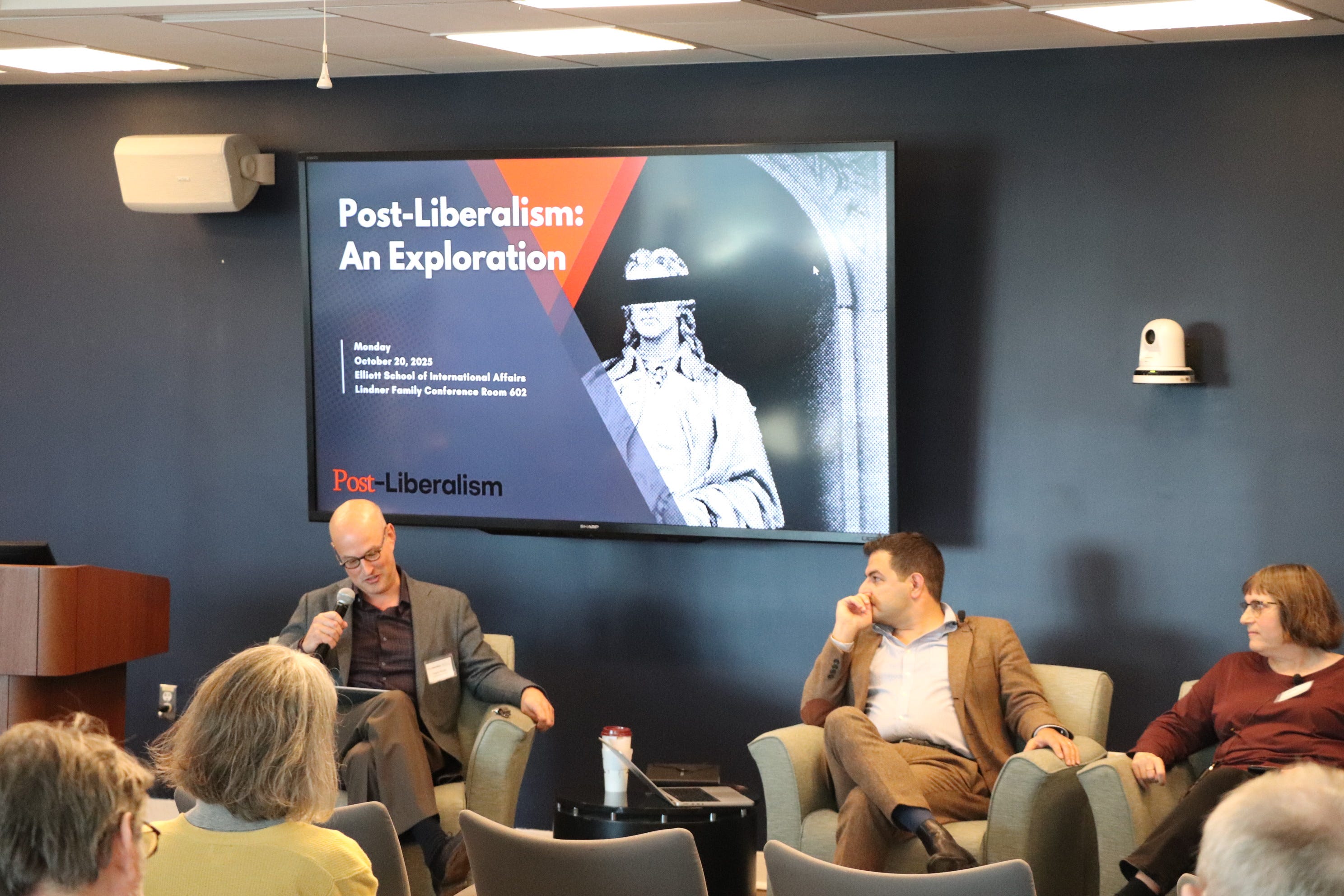
Angus Burgin (left), Sohrab Ahmari (center), and Elizabeth Anderson (right) in discussion at the Post-Liberalism: An Exploration conference. October 20, 2025.
Is there any prospect for policy cooperation between post-liberals and left-liberals? I call “left-liberals” anyone who supports identity and lifestyle pluralism and social equality while rejecting the neoliberal economic consensus that dominated U.S. policymaking from 1980-2016. I call “post-liberals” people who reject neoliberalism, but who also reject pluralism and social equality. All our disagreements on social issues concerning immigration, religion, race, gender, sexuality, reproductive freedom, and family organization come down to disagreements about pluralism and equality. Despite our profound disagreements on these issues, it seems to me that there may be room for building agreement on economic issues.
Suppose we take the proclaimed post-liberal aspirations seriously to (1) improve the economic prospects of the working class and (2) enhance the flourishing of local communities across the United States. At the October 2025 Post-liberalism: An Exploration conference at The George Washington University, my co-panelist Sohrab Ahmari proposed post-WWII European Christian democracy as a model for the right. I have recently defended social democracy as a model for left-liberals. These two models, Christian and social democracy, are united in their commitment to democracy and both flourished in the postwar era in liberal democratic Europe. Many technological, economic, and social circumstances have changed since then, which would require substantial updating of both models for the 21st century. In this short post, I’ll propose some modest steps forward in economic policy that I think could enjoy broad support across the electorate. Cross-party cooperation on these steps could do much to restore confidence in democracy, reduce partisan polarization, and enable Americans to take more ambitious steps to ensure that the economy works for ordinary people across the entire country, and not just for urban elites.
By many measures, the U.S. economy has never been richer. So why is discontent with our neoliberal capitalist order so widespread? The short answer is that labor’s share of national income has been trending down since its peak in 1970, and its distribution has been increasingly concentrated at the top. Moreover, opportunities for economic advancement are concentrated in a handful of major metros that are unaffordable to most Americans. Trade agreements since the 1990s have also deindustrialized many places in the U.S. So we have increasing geographic inequality. The economy in aggregate terms may be strong. But millions of Americans are suffering poverty, precarity, limited prospects for advancement, and are living in stagnant or declining communities.
These problems have many causes. Immigration is not to blame: it has increased the wages of native-born Americans. But other neoliberal policies beyond global trade have played key roles in suppressing wages and promoting inequality since 1980s. Until the Covid-19 recession, the federal government practiced austerity macroeconomics, which undermined the long-term prospects of people entering the job market. Labor unions have been under assault since Ronald Reagan’s presidency, assisted by adverse judicial interpretations of labor law. Many labor-protecting regulations, particularly at the state level, have been weakened or are barely enforced. Employees’ legal rights are regularly nullified by employment contracts that include noncompete clauses, mandate arbitration, and ban class actions. Financialization has enabled immense fortunes to be made on Wall Street, based on zero-sum trading of derivatives that does nothing to support the real economy. The virtual suspension of antitrust enforcement has led to monopsonistic wage suppression, primarily in rural areas.
Reversing these policies would likely be popular across the country. Rural populist voters powered the antitrust movement in the late 19th century. They have strong reasons to support it today, given the monopsony power of “big ag.” Labor unions enjoy supermajority support across the U.S. Laws to strengthen the ability of unions to organize and force employers to engage in good-faith bargaining would put that support into practice. Raising the minimum wage is very popular, including in red states. Noncompete clauses, mandatory arbitration, and bans on class action suits by workers should be banned as unfair to workers.
Americans across our political divide were rightly outraged by the failure of the Obama administration to prosecute the financiers whose fraudulent dealings in worthless mortgage-backed securities brought the economy to its knees. Finance should serve the real economy, not enable great fortunes to be made by creating and trading fake assets. Some of the government-bestowed power of national banks to issue loans and thereby create assets out of thin air could be usefully redistributed to credit unions and community banks which, by charter, are dedicated to serving the needs of their depositors rather than promoting zero-sum financial speculation. This could provide resources for revitalizing local communities and distributing economic opportunities more equitably across rural areas and small towns and cities. Such measures could improve the prospects of those who can’t afford to live in the major metros.
I propose these policies as starting points for experimentation. Many ideas must be tried to see what kinds of policies would help ordinary Americans. Seriously attempting economic policy experiments that are explicitly aimed at ordinary Americans rather than elites could have positive effects for democracy and political polarization. It’s not just elite failure, but the profound intergroup distrust, contempt and even hatred that lies at the heart of our democratic crisis. These hostile intergroup attitudes are unjustified. The vast majority of Americans are decent people, whatever their class, race, religion, gender identity, sexual orientation, immigration status, partisan affiliation, and place of residence.
Americans have a strong base of shared values. I worked on the American Academy of Arts and Sciences Commission on Reimagining the Economy from 2020-2023. The Commission included academics, business leaders, community leaders, and religious leaders with different viewpoints. We issued recommendations for economic policy based on the values that we found were shared by ordinary Americans. We organized listening sessions of Americans from 20 states including every region of the U.S. and every community type (rural, suburban, urban), across different ages, incomes, occupations, education levels, religions, racial identities, immigration status, party affiliations, religions, and so forth.
Again and again, we heard people expressing the same values and aspirations for the economy. Virtually everyone wants to actively support themselves and their families, serve and strengthen their communities, and be able to make long-term plans beyond bare day-to-day survival. This requires real opportunities to earn a steady income that covers basic needs with enough left over to accumulate savings. It also requires housing, health care, and education to be affordable. Americans want enough time to spend with their families, serve their communities, and enjoy some leisure. They want their communities to have the resources and investment they need to flourish. And they want a more democratic country, one that is responsive to their needs and not just elite interests.
I think if Americans listened in to these sessions (which the Library of Congress plans to make available), our trust in people different from ourselves by social identity, region, religion, immigration status and so forth would increase. We share more values than we think. If left-liberals and post-liberals recognized that and worked together on economic policies attuned to the shared concerns of ordinary Americans across the country, we would thereby promote intergroup trust and toleration and restore our faith in democracy. This, in turn, would strengthen democracy itself.
Elizabeth Anderson is Arthur F. Thurnau Professor and John Dewey Distinguished University Professor of Philosophy and Women’s Studies at the University of Michigan and specializes in political philosophy, ethics, and philosophy of economics.
The invocations of “democracy” in here seem to just be basically sentiment (“restoring confidence,” “shared values,” “responsive policy”) not actual institutional structural design, which is where lower case "d" democracy actually lives.
democracy in a lower-case “d” sense is not primarily about whether policies are perceived as being nice or whether people feel heard, it’s about whether people have meaningful, structured access to authority and decision-making power. The proposals here (antitrust, unions, credit redistribution, etc.), well, the implication I get is that they would remain situated within a deeply centralized universally-applied rigid policy framework, even in cases when when they gesture toward local revitalization.
Historically, the USA's system combined policy with structural plurality, local fiscal dominance, decentralized and pluralized capital structures, publicly accessible and internally contestable mass-member parties, and real legal/regulatory variability and policy variability across jurisdictions. That architecture enabled participation through governance, not just reception of policy.
Without restoring those kinds of distributed institutional levers, “democracy” risks becoming a descriptive or aspirational label rather than a structural reality
A liberal is someone who does not believe he, she, or they have a monopoly on truth. A liberal abhors tyranny, autocracy, and oligarchy. This is why liberals work to support the ideas and practices of a constitutional rule of law. It’s why liberals tend to reject any claim to authority that is not supported by consent, and try to change (or resist) any form of governance not legitimated by a popularly instituted constitution and body of law. Liberals strive to ensure that all attempts at reform or resistance be done under the color of law.
Anyone who claims that they, she, or he has a monopoly on truth is probably not a liberal. Liberals strive to tolerate such people. Anyone who advocates imposing their own version of truth, goodness, morality, or religion on others is almost certainly not a liberal. Liberals strive to oppose such ideas vigorously while just as vigorously defending the rights of some to hold such obnoxious, ugly, and thoroughly discredited ideas. Anyone who advocates using the law to FORCEFULLY impose their own versions of truth, morality, or goodness on those who are not a clear and present danger to others is even less likely to be a liberal. Liberals strive to oppose them mostly by organizing individuals and groups to clearly define how the public good does not justify such laws and how the public good would actually be more impaired than enhanced by such legislation. Anyone who tries to impose their own ideas about truth and goodness by ignoring and breaking the law is not a liberal, but should still be opposed as nonviolently as possible.
Liberals do not claim to have a monopoly on truth. This is why liberals (conservatives, progressives, moderates, traditionalists, and reformers) can and do disagree (often very strenuously) about how the public good should be defined, and which measures should be taken to increase it. Liberals can also fiercely disagree about how much nongovernmental authority (not based on consent) should be supported — as well as the extent to which irresponsible and unaccountable concentrated wealth should be tolerated even if it is not yet being used to exercise public power or to subvert democracy.
When someone identifies all of liberalism with “identity politics” or “moral relativism,” they are confused about what liberalism is, whether they identify as “liberal,” “post-liberal or “illiberal.” The same goes for anyone who identifies liberalism with capitalism. Modern liberalism is at least a century older than capitalism even if early (pre-capitalism) “liberals” supported private enterprise as a counter to the unchecked power of nobility and kings even as later liberals supported labor unions and an enlarged central government to counter the dangerous power of corporations and oligarchs.
Liberals do not claim to hold any monopoly on truth. Some look more to the past. Some look more to the future. Liberals can and should strenuously debate and experiment with 21st-century measures to distribute power and authority across a world economy still distorted and terrorized by imperialism and colonialism while also seeking to experiment with measures to build more economic democracy and individual self-determination everywhere in their home countries.
Despite our healthy (and sometimes unhealthy) differences, liberals should be “awake” enough — especially right now — to put them aside to resist, reform, and perhaps combat (as nonviolently as possible) the clear and present dangers of illiberalism.