

Postliberalism, Public Policy, and Politics: A Critical Perspective
By Stan Veuger

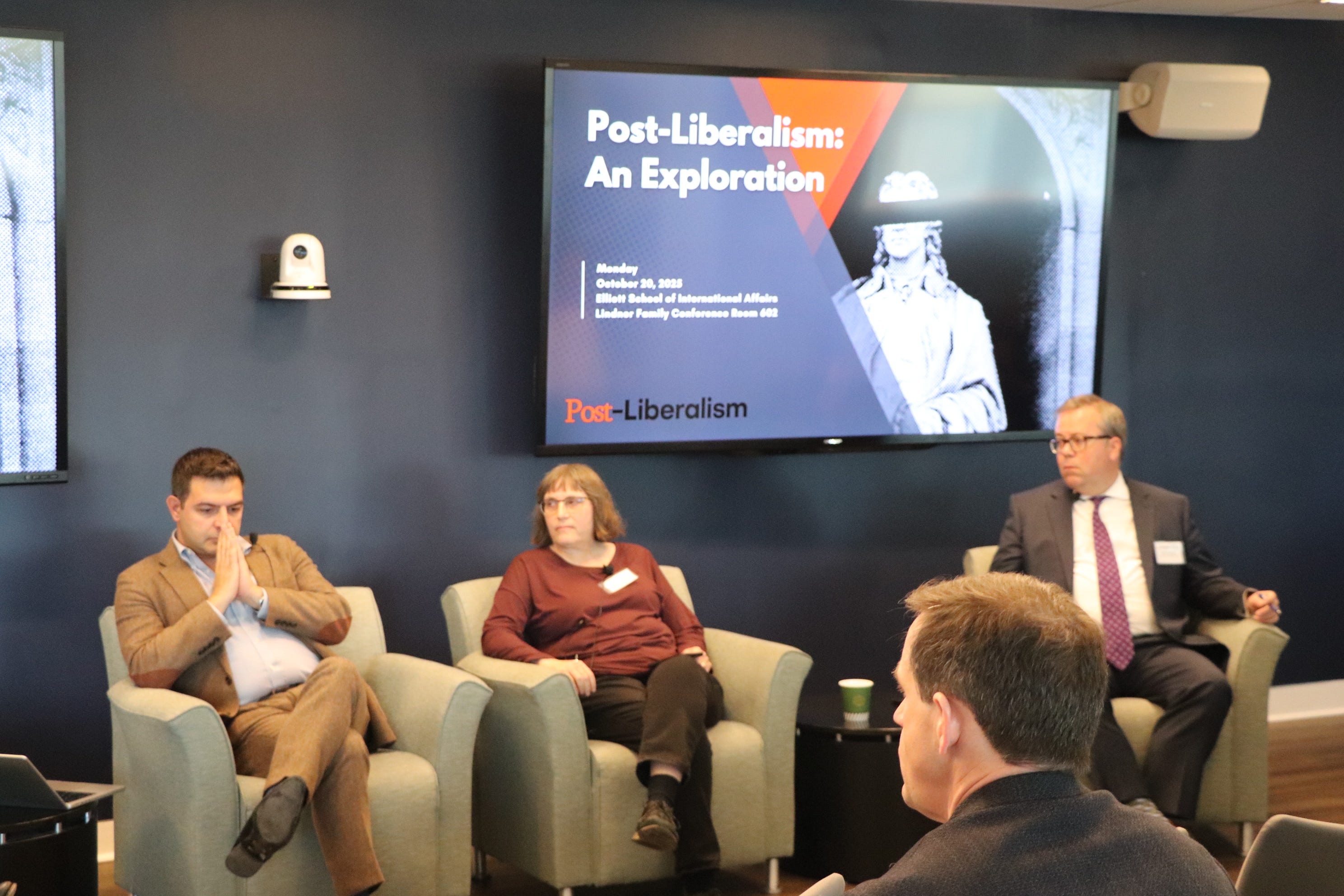
Sohrab Ahmari (left), Elizabeth Anderson (center), and Stan Veuger (right) in discussion at the Post-Liberalism: An Exploration conference. October 20, 2025.
This article is based on comments delivered at the Institute for European, Russian, and Eurasian Studies conference “Post-Liberalism: An Exploration,” held on October 20, 2025, at The George Washington University.
Defining Postliberalism
So-called postliberalism is better defined by what it opposes than by what it supports. Adrian Vermeule wants to centralize government entirely and have one ruler embody it; Patrick Deneen traffics in warmed-over Tocquevillianism without the liberalism and emphasizes local control. At a recent conference hosted by the Institute for European, Russian, and Eurasian Studies at the George Washington University—this article is a version of my comments there—speakers with postliberal sympathies tried to frame both the Biden administration’s social democratic economic policies as well as European Christian democracy as postliberal.
But whatever they claim to support is typically thinly sketched out, poorly thought through, and illustrative of political theory at its worst. As my AEI colleague Peter Wallison put it in a review of Vermeule’s Common Good Constitutionalism:
“Clichés like “the genuinely common good of political life is the happiness or flourishing of the community, the well-ordered life in the polis,” just won’t do. But at the end of the day, that’s all he is offering.”
All that is indicative of the fact that what unites postliberals, as they actually exist in the intellectual sphere in American politics and policy, is that they dislike liberalism and liberals. A more fruitful way to think about them is as opposed-to-liberalism or anti-liberal rather than as post-liberal. As Julian Waller has written, “[f]or nearly all postliberals, discontent with the regime type of liberal democracy… is widespread, and asserted to not be the only way one can organize political and social order in the 21st century. All share the reactionary mode of disgust with and disdain for the contemporary cultural and political status quo.”
Their disdain for the status quo stems from and manifests itself as opposition to immigration, to free trade, to LGBT rights, to due process, to international law, to multilateral organizations, to vaccines, etc., in different combinations and to different extents but always combined with a deep hatred of mainstream economics. That is how to think of them.
If our goal is to understand postliberals as a political movement with priorities for public policy and modes of governance, it is not particularly productive to treat each postliberal’s specific qualms as meaningful. This is particularly true—and I know this does not sound nice—because approximately no one would care about their ideas were it not for the electoral successes of right-wing populists at home and abroad. It is the elected officials, political parties, and public policies they associate themselves with and who associate themselves with them that make them interesting, to the extent that they are. (The publication records of all but a couple of them bear testament to the limited traction their philosophizing has otherwise gained.)
Postliberal Policy
One reason why analyses of postliberal writing are often focused on theoretical differences between flavors of postliberalism is because it is a movement that operates heavily within the sphere of legal and political philosophy, without putting much thought into public policy.
This has, for the practitioners of postliberalism, at least three advantages.
First, they do not have to bridge their own differences. It is much easier to complain about liberalism and juxtapose it with “well-ordered life in the polis,” than to think through the pros and cons of centralization in rigorous fashion, or to consider and predict and agree on the implications of, say, sudden shifts in or even the details of trade policy. It is certainly easier to blame malicious foreigners or lambast globalists for allegedly betraying America’s workers.
Second, they can remain at a distance from the policies that are implemented in their names. Something you will hear from postliberals is that they are interested in revitalizing local communities, and they will point to neoliberal policies in the immigration and trade sphere and claim they have devastated said communities.
What you will not hear from them is how stripping large numbers of US residents of their Temporary Protected Status helps bring communities together. What they will not do is express concern let alone opposition when immigration enforcement actions trigger massive, negative responses from the local communities they claim to want to strengthen.
Third, it is not clear that their movement is capable of serious policy analysis. To take one salient example: twenty years ago, Patrick Deneen, one of the most prominent postliberal academics, was already auguring the inevitable failure of liberalism, as he does today. What would trigger it back then was one of those intrinsic limits to growth that the enemies of capitalism always see around the corner, peak oil. Peak oil—world petroleum production at its maximum possible level before precipitously declining, culminating in “nature’s reassertion of her authority”—has been predicted for almost as long and almost as erroneously as the Second Coming. Here is how Deneen described some of its “imminent” consequences:
“[D]eclining amounts of energy raises serious questions about the viability of “globalization.” (..) A contraction of the economy will occur, and with it, the basis of many of the jobs that now result from an economy based upon growth. Much of the financial services industry will unravel; indeed, banking itself will come under extreme stress as fiat currencies loose value worldwide, and inflation makes existing and future loans increasingly worthless and dries up sources of investment. (..) Movement of products and people will become more difficult and less frequent. There is significant question about the future viability of commercial aviation. (..) The imminence of peak oil directly and adversely impacts our ability to grow and transport sufficient quantities of food. (..) As far-fetched as these “prophecies” might seem, they are the logical extrapolation of the reality of declining worldwide energy, and with it, declining wealth and the end of expansion and growth. (..) [P]eak oil portends the end of a particular aspect of modernity, the end of liberalism.”
Oil demand and supply—and more importantly for staving off the apocalypse, energy demand and supply--have of course continued to grow. The disappearance of the empirical foundation for his prognostications did not change Deneen’s faith in said prognostications one bit.. In fact, ten years later he published Why Liberalism Failed, in which oil or energy resources no longer even make an appearance and we are back in a safe space free of nasty specifics.
Or think of trade policy. For years now, postliberals and their political allies have complained about the relatively free movement of goods and capital that characterized the quarter century before the first Trump presidency. In this context, the major complaint about liberated trade flows is that they may have been beneficial in the aggregate but created losers in addition to winners, disrupting economic life in some communities. We are now engaged in a much more aggressive version of the same experiment in the opposite direction, with rapid increases in tariffs on practically all imports. Has a single postliberal or national conservative pondered how this will disrupt local communities, while also being harmful in the aggregate? Of course not, and any critic can be written off as a “liberal,” the kulak of postliberalism.
Postliberal Politics
As postliberals are motivated more by what they oppose than what they support, everyday politics is relatively straightforward for them. Embrace the enemy of your enemy, and progress will ensue. Are large corporations woke? Then let’s work with neo-Brandeisian antitrust types. Do Bernie Sanders and Elizabeth Warren have an anti-usury policy proposal? Here we go! Is there a number of antisemites who oppose aid to Ukraine, and a set of anti-Muslim agitators who oppose immigration? Postliberals welcome them without hesitation.
This sounds a little thin, and it puts postliberals who engage in political punditry more than political philosophy in a difficult spot. They are supposed to be deep thinkers. They cannot just say, “Well, my incredibly profound political philosophy leads to the inevitable conclusion that I must support whatever Donald Trump and Stephen Miller cook up.” That is simply not their role in the discourse.
And this is where we enter the land of absurdity. I referred earlier to the speaker who tried to frame Christian democracy as postliberal (or preliberal, to continue the semantic games), my fellow panelist Sohrab Ahmari. Let’s think about how this fits in with what we have learned about postliberalism.
Mr. Ahmari does not, of course, mean that he supports Christian democracy as it actually exists, represented by political parties like the German CDU or the Dutch CDA. Actually existing Christian democracy represents a century and a half of reflection, politicking, engaging with the world, and attempting to win elections. Embracing what real-world Christian democratic parties bring to the table would force Mr. Ahmari to embrace numerous viewpoints at odds with his own, including a tradition of center-right moderation, religious diversity, and a broad commitment to free trade. Instead, what he refers to as Christian democracy is a set of impulses derived from his own reading of Leo XIII’s encyclical Rerum Novarum, combined with nostalgia for the 1950s.
That is fine and perhaps interesting, but it is not, of course, Christian democracy. It is the same rhetorical move discussed earlier. Mr. Ahmari’s project involves the creation of yet another slightly different flavor of postliberalism that allows one to remain at a distance of specific policies, lets one avoid having to think through trade-offs or engage in serious policy analysis, and, perhaps most importantly, vaguely hints at supporting whatever national conservative elected officials do without expressly saying so.
Stan Veuger is a senior fellow in economic policy studies at the American Enterprise Institute (AEI), the editor of AEI Economic Perspectives, and an affiliate of AEI’s Center on Opportunity and Social Mobility. He is also a visiting lecturer of economics at Harvard University, an affiliate of Harvard’s Center for American Political Studies, and a fellow at the IE School of Politics, Economics, and Global Affairs. He was a Campbell Visiting Fellow at the Hoover Institution in May 2022.