

What If Postliberalism Were on the Left?
By Marlene Laruelle

This article was originally published on Marlene Laruelle’s Substack, Vivatopia.
Postliberalism is usually treated as a language of the right: a revolt against liberal individualism in the name of authority, tradition, and religion. But this association is too narrow. Postliberalism can mean two different things. In a thin sense, it names a historical condition: the weakening of liberalism’s cultural authority and the fact that liberalism no longer organizes the political imagination as it once did. In a thicker sense, it names projects of reconstruction that seek to build political life after liberalism.
These projects are often received as conservative or right-leaning, especially when grounded in natural law, Christian anthropology, tradition, or moral accounts of the common good. But the picture is more complicated: some postliberal currents, especially in Britain, with John Milbank and Adrian Pabst, have drawn on Christian socialism, guild traditions, and communitarian critiques of capitalism.
This raises a broader analytical question: whether some of postliberalism’s central concerns, especially the critique of market society and the rejection of liberalism’s ideal of limitless expansion, can also be articulated from a radical left perspective.
This essay explores that possibility through the language of the commons. It asks what a left postliberalism might conserve: not hierarchy, inherited privilege, or moral order imposed from above, but the living conditions of collective life, including the biospheric commons that sustain human existence, the non-appropriable commons that cannot belong to any one sovereign or owner, and the institutional commons through which communities govern shared resources and forms of mutual obligation.
A left postliberalism would be postliberal because it rejects the sovereign individual as the starting point of politics; left because it opposes domination, inequality, and capitalism; and conservative because it recognizes that some conditions of collective life must be protected rather than endlessly transformed.
In this sense, a left postliberalism would be postliberal because it rejects the sovereign individual as the starting point of politics; left because it opposes domination, inequality, and capitalism; and conservative because it recognizes that some conditions of collective life must be protected rather than endlessly transformed.
The Genealogy of a Left Conservatism
Left postliberalism should be understood today as one expression of a longer tradition of left conservatism. Postliberalism names the contemporary crisis: the exhaustion of liberal individualism, market society, and the ideal of limitless expansion. Left conservatism names the older intuition that emancipation cannot mean the destruction of every mutual obligation or solidarity. What joins them is the conviction that a politics of emancipation must also know what to conserve.
The left once had a language for conservation. It understood that capitalism was not only a system of exploitation but also a force of dissolution. Marx and Engels saw capital as revolutionary in the destructive sense: it liquefies inherited institutions and norms, uproots communities, subordinates place to exchange, and commodifies everything in its path, including human relations.
This is why one hears in the Manifesto that “All fixed, fast-frozen relations, with their train of ancient and venerable prejudices and opinions, are swept away, all new-formed ones become antiquated before they can ossify. All that is solid melts into air, all that is holy is profaned…” Insofar as this pertains to the public commons, Marx understood, from his early, liberal writings to his mature works like Capital, that it was precisely their enclosure and not their conservation that birthed and fueled capitalism.
But at the same time as this condition was analytically diagnosed by the left, it was also partly venerated and cheered on. Capitalism, for its faults, was still the most admirable mode of production in human history. Much of the left thus absorbed the other half of capitalism’s promise: that economic growth, expansion, was the path to emancipation. This was the left’s blind spot. An anti-capitalism without anti-productivism remains trapped inside capitalism’s imagination.
Nowadays, an anti-capitalism that fails to break with liberalism has the same problem at the level of social ontology. It may oppose markets and capital, but it still treats the individual as prior to community and progress as an unquestioned good.
The result has been a strange asymmetry. Today’s left speaks of conserving nature but celebrates the material forms and ideological scaffolding that permit the permanent transformation of society in the name of individual freedoms. The right noticed that contradiction long ago, and claimed the vocabulary of conservation for itself.
Within socialism, there have always been anti-modern currents that understood the defense of place, community, and inherited forms of life as inseparable from the emancipatory project.
But within socialism, there have always been anti-modern currents that understood the defense of place, community, and inherited forms of life as inseparable from the emancipatory project. From Proudhon and Lafargue to Péguy, Simone Weil, George Orwell, Christopher Lasch, and Jean-Claude Michéa, this tradition kept alive what the mainstream left abandoned: the recognition that you cannot liberate people from a living world you have already destroyed. What these figures mostly fought/fight for is stopping capitalism in its tracks and reversing its damage, not working through capitalism on the road to a “brighter future.”
But within socialism, there have always been anti-modern currents that understood the defense of place, community, and inherited forms of life as inseparable from the emancipatory project. From Proudhon and Lafargue to Péguy, Simone Weil, George Orwell, Christopher Lasch, and Jean-Claude Michéa, this tradition kept alive what the mainstream left abandoned: the recognition that you cannot liberate people from a living world you have already destroyed. What these figures mostly fought/fight for is stopping capitalism in its tracks and reversing its damage, not working through capitalism on the road to a “brighter future.”
A parallel recovery has come from outside socialism altogether: John Milbank and Adrian Pabst, writing from within a Christian and communitarian tradition, have reconstructed much of the same ground, recovering associationism and guild socialism against market individualism.
The question was thus never whether to conserve. Every politics conserves something. Liberalism conserves the rights-bearing individual and the market society that promises to protect their choices. Conservatism conserves hierarchy, inheritance, and the authority of institutions that claim to speak for the moral order. A left conservatism attempts to conserve, or more exactly to reinvent, the living conditions of collective life.
Governing What We Cannot Own
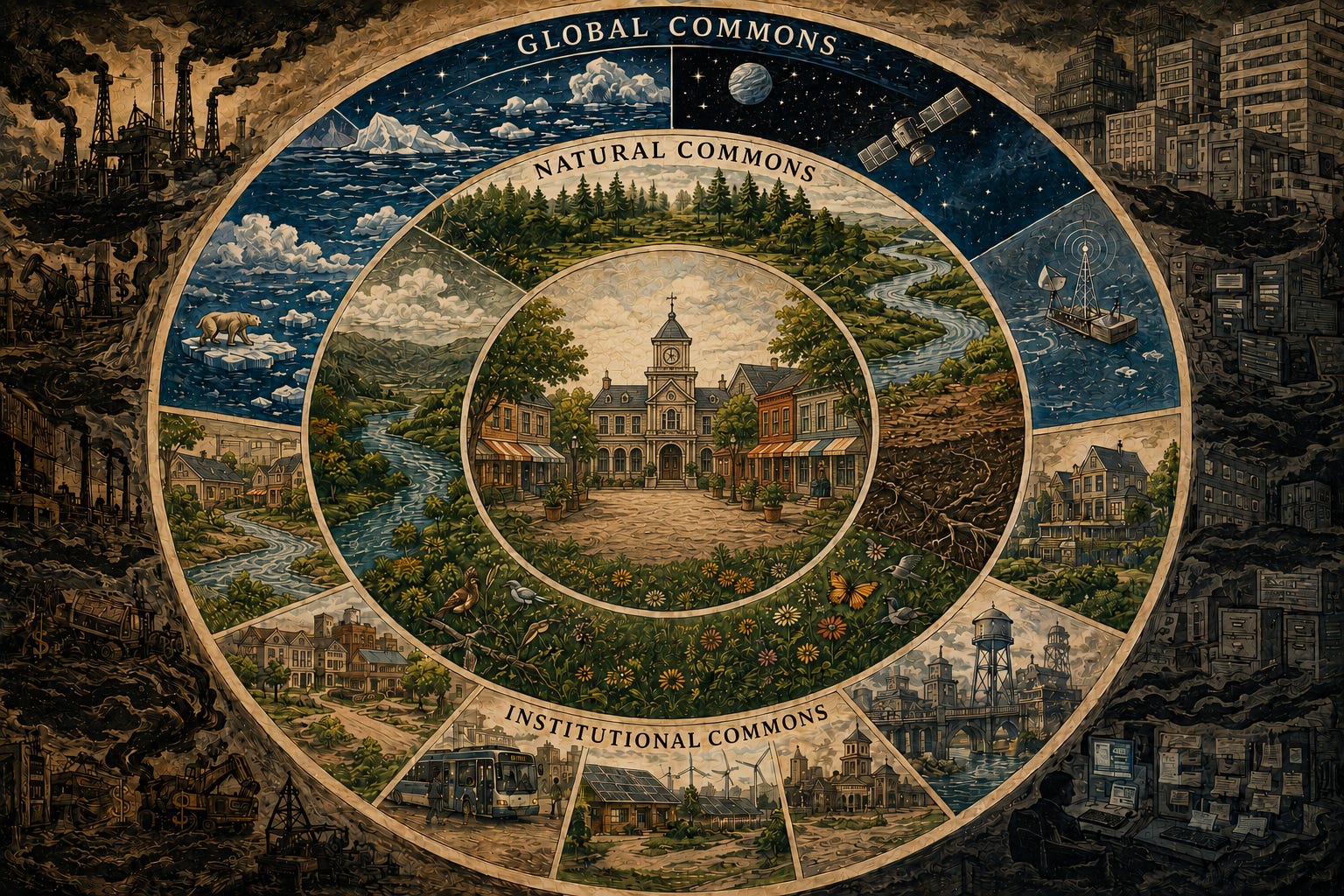
This is where the commons matter. “The Commons” can be usefully employed as a catchall term that names the shared substrates of human community and ecological life. It begins from a simple recognition: we all depend together on things that none of us created alone and none of us can preserve alone.
There are at least three levels to this politics of the commons.
The first is the biospheric commons. This includes the atmosphere, oceans, soil, watersheds, forests, and biodiversity; that is, the living systems that precede political institutions and make them possible. They are not resources to be allocated but conditions of existence, and their degradation is not a market failure but a civilizational one. They force us to think of humanity as a collective steward of planetary life.
The second is the non-appropriable commons. This includes outer space, the deep seabed, the Antarctic, and the electromagnetic spectrum, all the domains that international law has affirmatively placed outside sovereign or private ownership.
The third is the institutional commons: community land trusts, cooperatives, municipal infrastructures, local energy systems, urban collaborative pacts, and the dense middle layer of institutions that stand between isolated individuals and centralized administration.
This is the world Elinor Ostrom helped recover in her Governing the Commons: communities can self-govern shared resources through rules, obligations, monitoring, sanctions, and trust.
This is the world Elinor Ostrom helped recover in her Governing the Commons: communities can self-govern shared resources through rules, obligations, monitoring, sanctions, and trust. This distinction matters because much of modern politics has been organized around a misplaced and in some sense misleading opposition between the state and the market.
Polycentric governance breaks that binary. It names a political order distributed across multiple, overlapping centers of decision ranging from municipalities, cooperatives, user associations, watershed councils, neighborhood assemblies, public agencies, and civic institutions. Each governs at the scale where knowledge, responsibility, and consequences are closest to those affected.
No Postliberalism Without Post-Growth?
The relational turn in anthropology and ecology deepens this account of the commons. It shows that the living world is not an external stock of resources placed before sovereign individuals, but a field of mutual relations and dependencies.
Philippe Descola showed that the Western division between nature and society is not universal. Many human communities have not treated nature as an external domain of inert objects awaiting extraction, but as a field of relations, obligations, meanings, and reciprocal limits. The commons recovers, in secular and institutional language, what Western naturalism displaced: nature as the substrate of collective life rather than an object placed before the sovereign human subject.
Ivan Illich’s critique of counter-productivity belongs here as well. Industrial society, for him, not only produces goods but also manufactures dependencies. Against this, Illich defended convivial tools: technical and institutional forms that enlarge people’s capacity to act with one another, rather than reducing them to clients, users, patients, or administered subjects. The commons belongs to this horizon: institutions governing shared life must remain intelligible and answerable enough to be governed by those who depend on them.
Postgrowth gives this argument its political-economic edge. André Gorz and Serge Latouche saw that emancipation cannot mean the infinite expansion of production. It must mean reducing the sphere of economic necessity, protecting time, care, autonomy, and non-market forms of life, focusing on a wellbeing and care-centered economy. Today, figures like the Japanese Marxist Kohei Saito are renewing a similar vision, putting forward a vision of “Degrowth Communism” in books like Slow Down and Marx in the Anthropocene.
Though it need not, and likely will not, begin from the same starting points nor go to such extremes, this general orientation is what distinguishes a left postliberalism from its liberal competitor. Indeed, in its center-left form, contemporary liberalism may prescribe green growth, regulate it, or redistribute some of its gains, but it does not break with the growth paradigm itself. Yet growth is an ontological commitment to illimitation: the belief that more is always the answer and that dependence can be overcome through technique.
A politics of the commons says something different. There, the central conflict is not simply capital versus labor, nor state versus market, but the living world versus systems of illimitation, be they economic, consumerist, bureaucratic, technological, or algorithmic.
A Pluralist Common Good
This is why the commons differs from the right-wing version of postliberal “common good.” The common good is usually a moral-teleological concept, if not an outright metaphysical one. It asks what humans are for, what the good life is, and what order best conforms to human nature or divine law. It tends toward singularity and requires someone to define it: Church, state, philosopher, jurist, or some other kind of authority besides. It can produce a powerful critique of liberal fragmentation, but it also risks turning plural life into a single moral architecture.
The commons is less metaphysical and more empirical. It does not ask everyone to agree on what humans are for before politics can begin. It begins from shared dependency and is plural by design. Different communities can govern different commons by different rules. It is also post-Western because it breaks with the Western naturalist fantasy that politics begins from the sovereign individual.
This does not make the commons anti-religious. On the contrary, it creates an ecumenical terrain. Catholic social thought arrives at the commons through integral ecology, subsidiarity, and the subordination of markets to social obligations, from Laudato Si’s integral ecology and Laudato Deum’s critique of the technocratic paradigm to Leo XIV’s recent call for AI to be a collectively governed common good. Liberation theology can arrive there from below by focusing on the poor, the community, or the land. Secular socialism can arrive there through anti-capitalism and anti-productivism.
This convergence defines the political space a left postliberalism could occupy: secular and pluralist, but not liberal; ecological and communitarian, but not reactionary; conservative in what it protects, radical in what it opposes.
This convergence defines the political space a left postliberalism could occupy: secular and pluralist, but not liberal; ecological and communitarian, but not reactionary; conservative in what it protects, radical in what it opposes.
It is also broad enough to act as a coalition-builder because it identifies shared enemies and shared stakes. With conservative figures, it shares the recognition that limits, place, and intergenerational obligation are conditions for human flourishing. With the ecological left, it shares the conviction that social justice and planetary boundaries are the same struggle.
Marlene Laruelle is a Full Professor in the Department of Political Science at Luiss University in Rome and the Director of the Illiberalism Studies Program at George Washington University in Washington, DC. Her current research focuses on the rise of illiberal and postliberal ideologies in Europe and the United States, with special attention to lived ideologies—how political commitments are expressed through ways of life, everyday practices, consumption, cultural codes, moral intuitions, and social attachments.